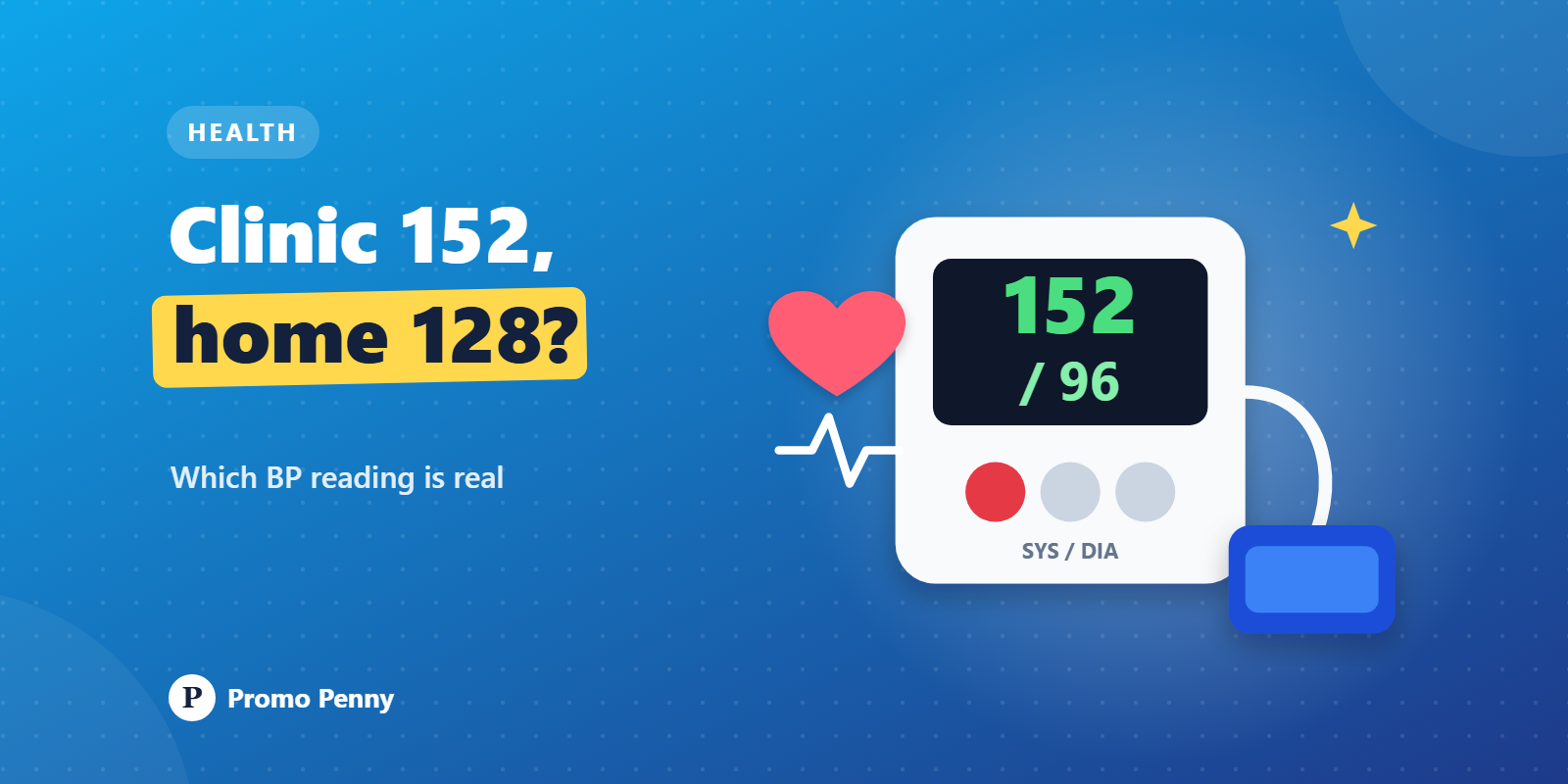
The doctor's assistant wraps the cuff, the machine whirs, and the screen says 152/96. At home, on your own monitor, you usually see something closer to 128/80. So which one is your real blood pressure?
Often the home number is nearer the truth, but only if you take it the right way. Done carelessly, home readings can be just as misleading as a rushed clinic check. Here's why the two places disagree, and how to get home numbers your doctor can actually use.
Blood pressure isn't a fixed number like your height. It moves from minute to minute with stress, movement, talking, a full bladder, a cup of tea, even the temperature of the room. A clinic visit stacks several of these at once. You've pushed through traffic, waited in a crowded room, climbed two floors because the lift was full, and then someone measures you while you're wondering what the result will mean.
For many people that's enough to push the reading up noticeably. When clinic readings are consistently high but readings taken outside the clinic are normal, doctors call it white-coat hypertension. It's common, and it's one reason hypertension guidelines now encourage doctors to confirm high BP with readings taken outside the clinic before starting lifelong medicine.
It's still worth rechecking every so often, since some people with white-coat hypertension go on to develop sustained high BP.
The reverse also happens. Some people have a perfectly normal reading at the clinic but high readings at home or through the working day. This is masked hypertension, and it's the more worrying of the two because a single clinic check gives false reassurance.
It tends to show up in people whose daily life pushes BP up: long stressful work hours, smoking, heavy drinking, poor sleep or sleep apnoea, diabetes or kidney disease. Someone who sits calmly in the clinic at 11 am may be running high at 8 am on a weekday after a bad night. Home monitoring is one of the few ways to catch it, which is a good argument for owning a monitor even if your clinic readings look fine.
Pick an automatic upper-arm monitor. Wrist monitors are very sensitive to the position of your hand, and finger devices or smartwatch BP features are not a substitute for a proper cuff. Look for a model that has been clinically validated for accuracy. Independent bodies such as the British and Irish Hypertension Society and the STRIDE BP initiative publish lists of validated devices, and your doctor or pharmacist can point you to one. A well-known brand name on the box is not the same thing as validation.
Then get the cuff size right, because this is where many home readings quietly go wrong. A cuff that's too small for your arm reads falsely high; one that's too large can read low. Measure around the middle of your upper arm with a tailor's tape and check that the number falls inside the range printed on the cuff. If your arm is larger than the standard range, buy the large cuff rather than squeezing into the one in the box.
Take the monitor along to your next clinic visit once and compare it with the clinic's reading. It's a simple way to check that your device and technique are in the right ballpark.
This sounds fussy. It is a little fussy. But each step removes a known source of error.
Use the same arm each time. At your first session it's reasonable to measure both arms; if one is consistently higher, use that one from then on and mention the difference to your doctor.
One reading tells you very little. A pattern tells you a lot.
A common approach in hypertension guidelines is to measure for seven days in a row before a doctor's appointment: two readings in the morning, before breakfast and before any BP medicine, and two in the evening, before dinner. Many doctors set aside the first day, when people are often a bit tense with the new routine, and average the rest.
A simple hypothetical: over six days you collect 24 readings, and the top (systolic) numbers add up to 3,240. Divide by 24 and your average systolic is 135. Do the same for the bottom (diastolic) number. That average says far more than the single scary 152 from the clinic, or the single pleasing 118 from a relaxed Sunday morning.
Keep a log: date, time, both numbers, pulse, which arm, and a note if something was unusual, such as a headache, a missed dose or a late night. Don't delete the high readings or keep repeating until you get a nicer number. Your doctor needs the honest spread.
Home readings are judged on a slightly different scale from clinic readings, because home numbers naturally run a little lower. Many guidelines treat a home average of 135/85 or above as high, compared with 140/90 in the clinic, and some use lower cut-offs. Your doctor will set the target that fits your age and health.
| What you see | What to do |
|---|---|
| Home average mostly below 135/85 | Keep up healthy habits and recheck as your doctor advises |
| Home average of 135/85 or above over a week | Book a doctor's appointment and take your log |
| Repeated readings of 160/100 or more | See a doctor within the next few days |
| 180/120 or more, no symptoms | Rest five minutes and recheck; if still that high, contact a doctor the same day |
| 180/120 or more, with symptoms | Emergency: call 108 or 112 |
The symptoms that turn a high reading into an emergency include chest pain, breathlessness, a sudden severe headache, blurred or lost vision, confusion, weakness or numbness on one side of the body, or difficulty speaking. Don't sit at home rechecking if you have any of these. Get help.
Low readings matter too. If your BP is regularly below about 90/60 and you feel dizzy, faint or unusually tired, especially after starting or changing a BP medicine, tell your doctor.
This article is general information, not medical advice. Please talk to a doctor about your own blood pressure readings and treatment.





























© 2026 Promo Penny. All rights reserved
Designed & Developed by IngeniousPro Team.