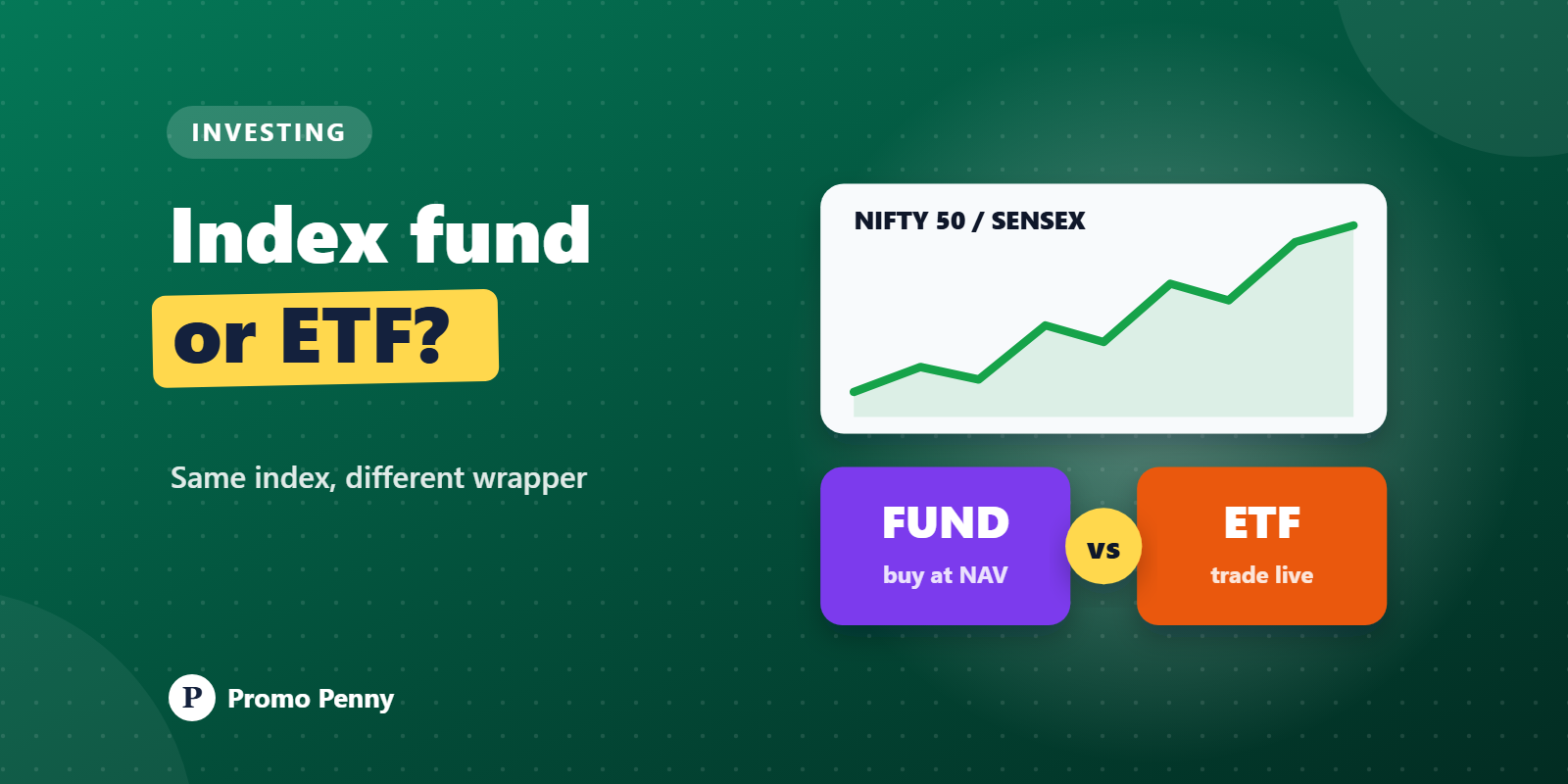
Say you have decided to invest in the Nifty 50 rather than pick individual stocks. Good. Now you face a second choice that confuses a lot of people: buy a Nifty 50 index fund, or a Nifty 50 ETF?
Both hold the same 50 companies in roughly the same proportions. Both aim to deliver the index's return, minus costs. The difference is mostly in how you buy, hold and sell them, and in a few costs that do not show up in the headline number.
An index fund is a mutual fund scheme. You put money in with the fund house (the AMC), and you get units at that day's NAV, the net asset value worked out after the market closes. When you want out, you redeem units with the fund house, again at the NAV. You never deal with another buyer or seller.
An ETF, or exchange traded fund, is also run by a fund house, but its units are listed on a stock exchange such as the NSE or BSE. You buy and sell them through a broker during market hours, at whatever price other investors are trading at that moment, just like a share.
Under the hood, both simply buy the stocks in the index. Neither has a fund manager trying to beat the market. That passive approach is the whole point, and it is why both are usually cheap compared with actively managed funds.
Every fund charges an annual fee called the expense ratio. You never pay it as a separate bill. It is taken out of the fund's assets bit by bit, so it quietly reduces the NAV. SEBI sets maximum limits on what funds can charge, and actual expense ratios are published by fund houses and on AMFI's website.
A simple hypothetical shows why it matters. On ₹1,00,000 invested:
The gap looks tiny, but it repeats every year on a growing amount, for as long as you stay invested. For passive funds tracking the same index, cost is one of the few real differences.
ETFs often have lower expense ratios than index funds on the same index. Index funds come in two versions: a direct plan, bought straight from the fund house or a direct platform, and a regular plan, bought through a distributor, which costs more because it includes commission. If you choose an index fund, the direct plan is the fair comparison with an ETF.
The second number to check is tracking error. No fund matches its index perfectly. Fees, cash held for redemptions, timing of trades and dividends all cause small gaps. Tracking error measures how much the fund's returns wobble around the index's returns. A related idea, often called tracking difference, is simply how far behind the index the fund ended up over a period. Lower is better on both. Fund houses publish tracking error in their factsheets, and comparing a few funds on the same index is quick.
For an ETF, yes. You need a demat account and a trading account with a broker, because the units are held in demat form and bought on the exchange. You may also pay brokerage and other transaction charges on each trade, depending on your broker.
For an index fund, no. You can invest through the fund house's website, a registrar's platform, or a mutual fund app, with just your KYC done. Your units show up in your mutual fund statement. Many people who are new to investing find this simpler.
Here is where ETFs need a little care.
With an index fund, you always transact at the NAV. With an ETF, you buy from and sell to other people on the exchange, so the price you get depends on who is willing to trade at that moment. Two things matter:
A few practical habits help. Look at trading volume before choosing an ETF. Use a limit order rather than a market order, so you decide the price. And avoid trading in the first and last few minutes of the session, when prices can jump around.
Fund houses deal directly in ETF units only in very large blocks, so for an ordinary investor the exchange is the only realistic way in and out.
If you want to invest a fixed amount every month, index funds make it effortless. You set up a SIP of, say, ₹5,000 on the 5th of each month, the money is debited automatically, and you get units for the full amount, including fractions of a unit.
ETFs can be bought regularly too, and some brokers offer a SIP-like feature for them. But you buy whole units at market price, so if a unit costs ₹260, your ₹5,000 buys 19 units with ₹60 left over, and each purchase may carry brokerage. It is doable. It just takes a bit more attention.
Tax on gains from equity index funds and equity ETFs is broadly similar, but tax rules change from time to time. Check the Income Tax Department's current rules or ask a tax professional rather than relying on old articles.
| If this sounds like you | Leans towards |
|---|---|
| No demat account, and no plan to open one | Index fund |
| Want an automatic monthly SIP you never have to touch | Index fund |
| Already have a demat account and are comfortable placing orders | Either; compare costs |
| Investing larger lump sums and want the lowest expense ratio | ETF, if it is well traded |
| Want to buy or sell at a specific price during market hours | ETF |
Whichever you pick, run the same short checklist:
The one thing to remember: the index decides most of your return. The wrapper decides how convenient and how cheap it is to own. Pick the index first, then the wrapper.
This article is for general education only and is not investment advice. Markets carry risk, so read the scheme documents and consider a SEBI-registered adviser for decisions about your own money.



























© 2026 Promo Penny. All rights reserved
Designed & Developed by IngeniousPro Team.