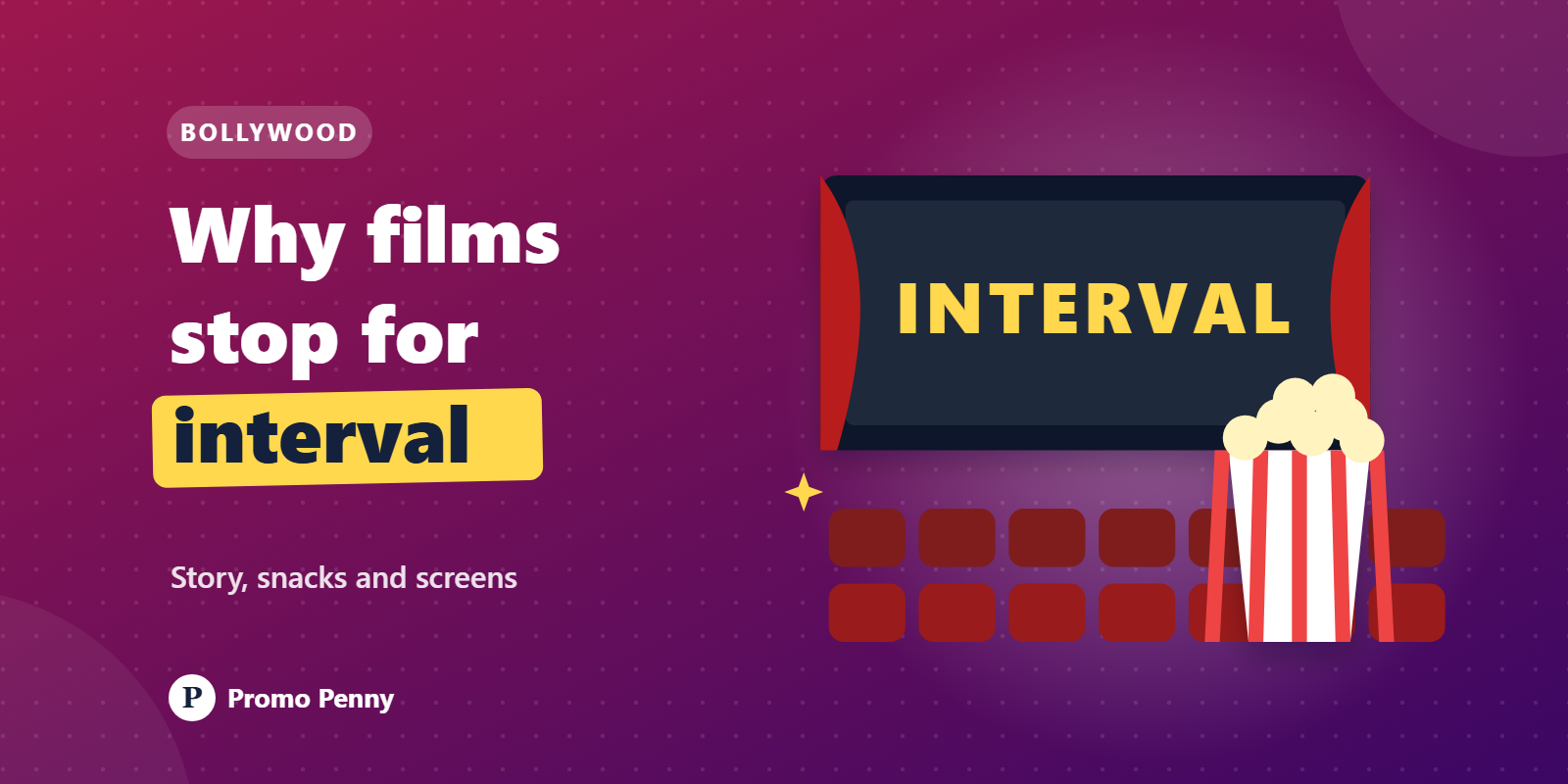
Halfway through almost any Hindi film in a theatre, the screen cuts to black, the word INTERVAL appears, the lights come up and half the hall heads for the food counter. In much of the world that pause has mostly disappeared. In India it has survived for decades, and it has quietly shaped how our films are written.
There are three reasons it's still here: length, story and money. They feed into each other.
Breaks are older than cinema. Stage plays have long paused between acts, and early Indian cinema borrowed heavily from popular theatre, Parsi theatre in particular. When films grew long, a pause in the middle felt natural.
Hollywood had intermissions too, mainly for big epics with long running times, the kind of film that opened with an overture before the first scene. As American films settled into a shorter standard length, the break faded out there.
Indian popular films went the other way. With songs, a comedy track, family drama, action and romance often packed into a single film, running times of two and a half to three hours were common for a long time. Few people sit through three hours comfortably without moving. A pause for tea, a snack or the toilet was simply practical, and once audiences expected it, the whole business arranged itself around it.
Once you know the story will stop for ten or fifteen minutes in the middle, you start writing for that moment. Indian filmmakers talk about the interval point or interval block: the sequence just before the break that sends people out buzzing and brings them back curious. In Telugu and Tamil cinema, a big one is often called an “interval bang”.
It tends to take a few familiar shapes:
This makes many Indian films a story in two halves rather than the three acts taught in Western screenwriting books. The first half sets up the world, the relationships and the problem. The interval block raises the stakes. The second half deals with the consequences.
It also explains a line you'll see in plenty of reviews: the film was “great till the interval” but sagged after it. Setting up a premise is often easier than delivering on it, and the interval draws a sharp line that makes any drop very easy to notice.
Picture a simple story, invented purely for illustration. A small-town schoolteacher finds out that the local contractor is building the new school with cheap cement. The first half shows her life, her students and her growing suspicion. Just before the break, she confronts him in public, and he calmly tells her that her own brother signed the papers.
Cut to INTERVAL.
The audience walks out with a question that matters: what will she do about family? The second half now has a clear job. Without the break, a writer might place that revelation anywhere. With it, the revelation becomes the hinge of the whole film.
For cinemas, the interval is not just a toilet break. It's their best selling time.
When you buy a ticket, a large part of that money doesn't stay with the cinema. After tax, ticket revenue is shared between the exhibitor, which is the cinema, and the distributor, who in turn pays the producer. The split varies from film to film and often from week to week. Food and drinks are different: that money belongs to the cinema. It's a big reason popcorn and cold drinks cost what they do in a multiplex.
The interval packs that buying into one rush. It's also a slot for on-screen ads and trailers, which bring in more income for the theatre. Many multiplexes now let you order from your seat or through an app, which spreads the rush out, but the logic is the same. For a small single-screen theatre, the canteen and the interval ads can make a real difference to whether the place stays open.
Foreign films shown in India are usually made to run straight through. Many Indian cinemas still put an interval in, somewhere around the halfway mark. Because the film wasn't written around that break, it can land in the middle of a conversation or a tense scene, which annoys a lot of viewers.
Some cinemas skip the break for certain foreign films or certain shows, and the practice varies by chain and city. If it matters to you, ask the cinema before you book.
Streaming has no interval. You pause whenever you like, and there's no food counter to keep busy. Films made directly for OTT can be shaped differently. Some keep the old two-half structure out of habit; others are built more like a long episode, with smaller hooks spread through so viewers don't drift away to their phones.
Many theatrical films also run shorter than the three-hour family entertainers of the past. A two-hour film doesn't really need a break for comfort, though theatres generally still take one, because the food counter still needs it.
Even so, the habit is strong. Plenty of big theatrical releases still run long, still have songs and still build towards one big interval block. It's fair to say a lot of viewers decide during those fifteen minutes whether they're enjoying the film, and word of mouth often starts in the queue for popcorn.
Once you start watching for the interval block, you see it everywhere. It's one of the most distinctly Indian things about how our films are built, and knowing it is there makes you a sharper viewer of both halves.





























© 2026 Promo Penny. All rights reserved
Designed & Developed by IngeniousPro Team.