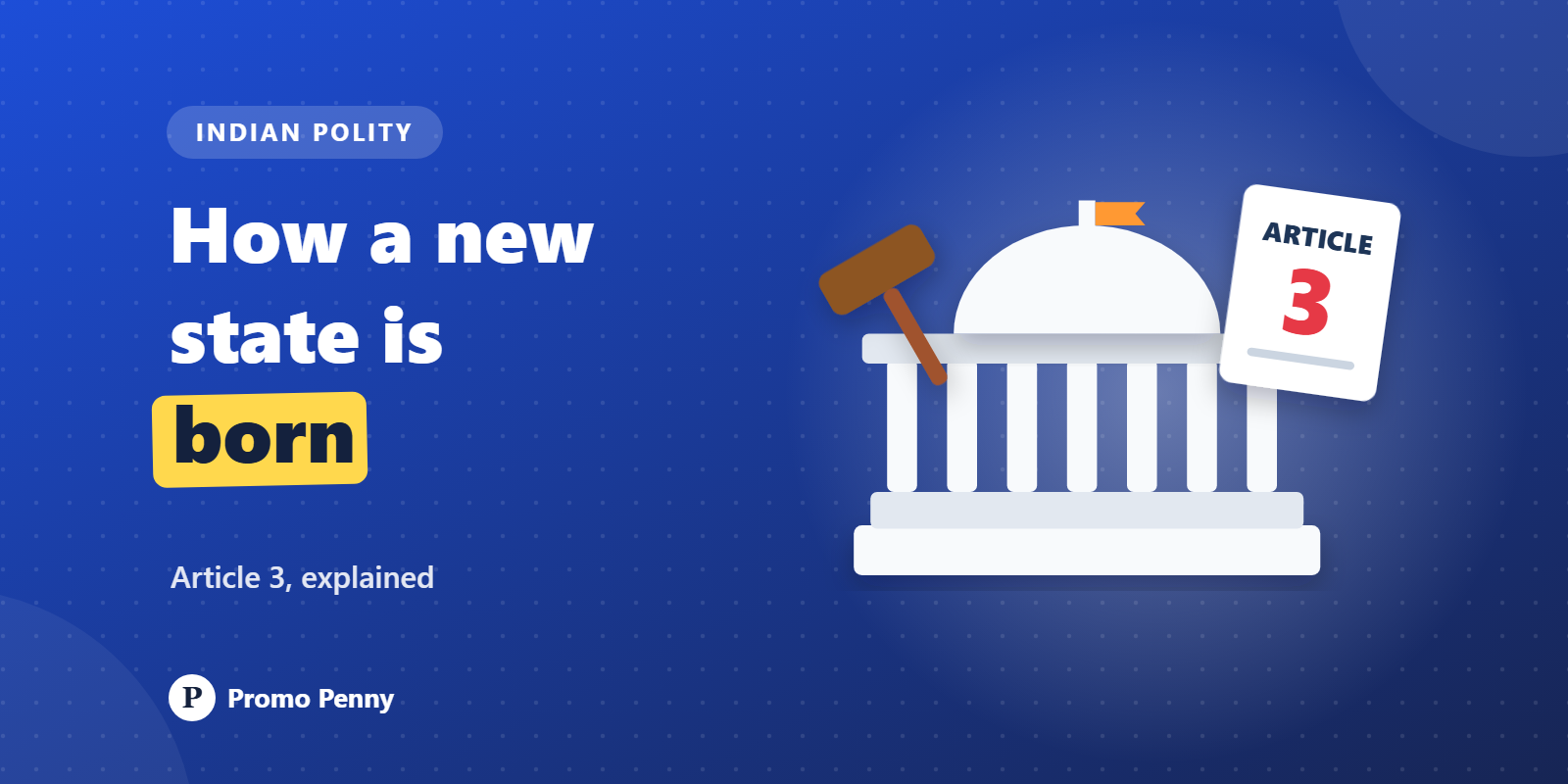
Here's a fact that surprises many people: Parliament can create a new state, merge states, change a state's boundaries or rename it through an ordinary law passed by a simple majority. The special procedure for amending the Constitution isn't needed.
That flexibility was deliberate. The framers knew the 1950 map was a patchwork of British provinces and princely states that would have to change. It did, many times.
The first few articles of the Constitution deal with the Union and its territory. Two of them are easy to confuse.
Article 2 lets Parliament admit new states into the Union, or establish them, on whatever terms it thinks fit. This is about territory that was not already part of India. Sikkim becoming a state in 1975 is the usual example.
Article 3 is about rearranging what is already inside India. Under it, Parliament can by law:
Almost every new state since independence was created under Article 3.
Article 4 completes the picture. It says such a law can also make the supplementary and consequential changes needed, such as seats in Parliament, a legislature and a high court for the new state, and that the law is not treated as an amendment of the Constitution under Article 368. That's why a simple majority is enough.
One limit is worth knowing. Article 3 is for changes inside India. In its Berubari opinion of 1960, the Supreme Court said that handing Indian territory to another country needs a constitutional amendment, not just an Article 3 law.
This design is why India is often described as an 'indestructible union of destructible states'. The Union is permanent. The individual state boundaries are not.
At independence, states were grouped into categories (later labelled Part A, B, C and D) that mostly reflected colonial history. Telugu speakers, for example, were split between Madras State and the princely state of Hyderabad.
The idea of linguistic provinces was old; the Congress had organised its own provincial committees by language well before independence. But after Partition, the national leadership was wary. A commission headed by S. K. Dhar, and then a committee of Jawaharlal Nehru, Vallabhbhai Patel and Pattabhi Sitaramayya (the JVP Committee), advised against rushing into linguistic reorganisation, mainly out of concern for national unity.
The turning point came from Madras State. Potti Sriramulu, a Gandhian, went on a fast demanding a separate state for Telugu speakers. He died in December 1952 after fasting for more than fifty days. Protests spread across the Telugu-speaking areas, and the government announced the new state soon after.
Andhra State came into being on 1 October 1953, carved out of Madras State, with Kurnool as its capital. It was the first major state formed mainly on the basis of language.
Andhra opened the door, and other demands followed quickly. In late 1953 the government set up the States Reorganisation Commission, chaired by Justice Fazl Ali, with H. N. Kunzru and K. M. Panikkar as members. It submitted its report in 1955.
The Commission accepted language as an important basis for drawing state boundaries but said it should not be the only one. Administrative convenience, economic viability and national unity mattered too.
The result was the States Reorganisation Act, 1956, which came into force on 1 November 1956. Together with the Seventh Amendment to the Constitution, it ended the old Part A/B/C/D system and reorganised the country into 14 states and 6 union territories. Kerala was formed, an enlarged Mysore state (renamed Karnataka in 1973) took shape, and Andhra was merged with the Telugu-speaking parts of Hyderabad to form Andhra Pradesh. That's why 1 November is a formation-day date for several states, Kerala and Karnataka among them.
In 2019, Parliament passed the Jammu and Kashmir Reorganisation Act, which converted the state of Jammu and Kashmir into two union territories, Jammu and Kashmir and Ladakh, with effect from 31 October 2019.
After Dadra and Nagar Haveli and Daman and Diu were merged into one union territory in 2020, India has 28 states and 8 union territories.
No. Its legislature must be consulted when a bill affects its area, boundaries or name, but Parliament isn't bound by its views. Telangana was created even though the undivided Andhra Pradesh assembly had rejected the draft bill.
No. A state has its own elected government with powers over the subjects in the State List. A union territory is administered by the Union through an administrator or Lieutenant Governor, though some, such as Delhi, Puducherry and Jammu and Kashmir, have legislatures with more limited powers.
Next time a news debate turns to carving out a new state, three points will help:
For the exact wording, read Articles 1 to 4 of the Constitution of India, published by the Legislative Department of the Ministry of Law and Justice. They're short and readable.






























© 2026 Promo Penny. All rights reserved
Designed & Developed by IngeniousPro Team.