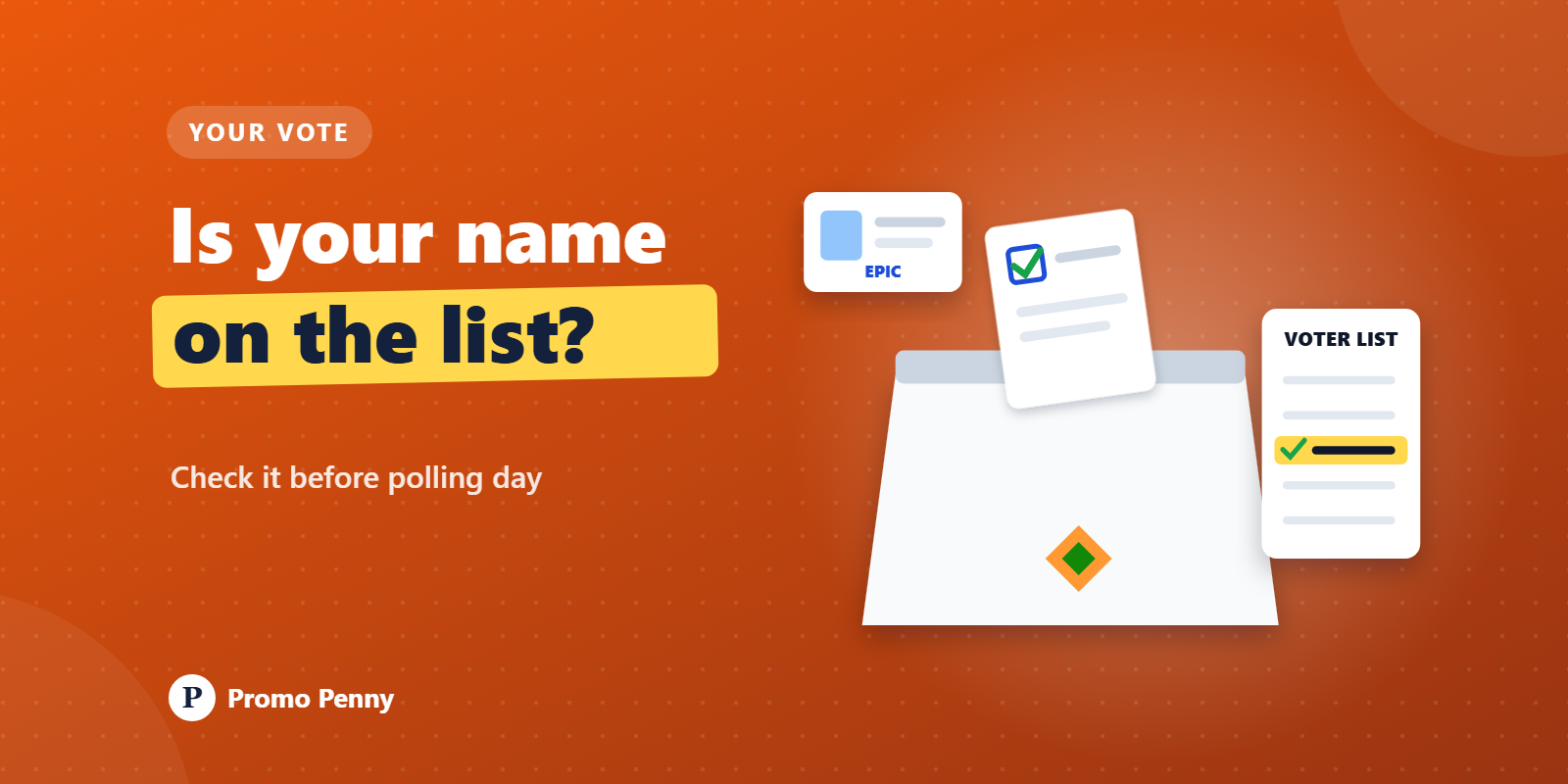
Having a voter ID card does not guarantee you can vote. What matters on polling day is whether your name is on the electoral roll for your polling station, and every election some people with a valid card reach the booth and find their name missing.
Checking takes about five minutes. Fixing a problem takes a few weeks. So the time to do both is now, not the week before voting.
Your voter ID card is officially the EPIC, the Electors Photo Identity Card. It proves who you are. The electoral roll is the actual list of voters, prepared constituency by constituency and split into parts, each part covering the area of one polling station.
Names can drop off the roll for ordinary reasons: you moved and someone reported it, a verification visit found the house locked, your entry was flagged as a duplicate, or there was a clerical error. Your card stays in your wallet the whole time, which is why people don't notice.
The Election Commission of India runs two official tools for this: the Voters' Service Portal website and the Voter Helpline app for Android and iPhone. Both have an electoral search option. You can usually search in three ways:
If you're found, note down three things: your part number, your serial number in that part, and the polling station name and address. These save a lot of time on voting day. You can also call the voter helpline on 1950 for help.
Not found? Before panicking, try spelling variations of your name and your parent's name (English spellings vary a lot), widen the age, and check whether you might still be listed at an old address. If you still can't find yourself, you'll need one of the forms below.
All of these can be filed online through the Voters' Service Portal or the Voter Helpline app, or on paper with your Electoral Registration Officer or Booth Level Officer.
| Form | Use it for |
|---|---|
| Form 6 | New registration: first-time voters, or anyone not enrolled anywhere |
| Form 6A | Indian citizens living abroad who want to register as overseas electors |
| Form 7 | Objecting to a name on the roll, or seeking deletion, for example of a family member who has died |
| Form 8 | Shifting residence, correcting entries, getting a replacement EPIC, or marking yourself as a person with disability |
You must be an Indian citizen aged 18 or more on the qualifying date. There are now four qualifying dates a year (1 January, 1 April, 1 July and 1 October), and 17-year-olds can apply in advance so their name is added once they turn 18.
Use it to remove the name of a deceased relative, or to object to an entry you know is wrong. Making a false objection is an offence, so use it carefully.
Moved from one flat to another in the same city, or from Lucknow to Bengaluru? Form 8 handles shifting, both within your constituency and to a new one. The same form corrects a misspelt name, wrong age, wrong photo or wrong relative's name, issues a replacement card if yours is lost or damaged, and lets you mark yourself as a person with disability so the polling station can offer help such as ramps or priority entry.
One rule to keep in mind: you can be on only one electoral roll in the country. Shift your registration with Form 8; don't register afresh in the new city with Form 6 while your old entry stays.
The accepted list is printed with each form and can change, so check it when you apply. Renters and students living away from home often get stuck on address proof; a bank passbook updated to your current address or a registered rent agreement usually solves it.
Every polling station area has a Booth Level Officer (BLO), usually a local government employee such as a school teacher or anganwadi worker. The BLO keeps the roll for that area up to date, carries out house-to-house checks and may visit you to verify an application. You can find your BLO's name and phone number through the Voters' Service Portal or the Voter Helpline app.
The decision on your application is taken by the Electoral Registration Officer (ERO) for your constituency. Online applications give you a reference number so you can track the status. If your application is rejected, the order should state the reason, and you can reapply with better documents or appeal.
The roll is updated throughout the year, with a bigger annual revision. Once an election is announced, applications are still accepted for a while, but there's a cut-off: changes for that election stop around the last date for filing nominations. After that, the roll is effectively frozen until polling is over.
Verification also takes time. An application filed a few days before the cut-off may not be processed in time. Aim to check your name and fix problems at least two to three months before any expected election, then check again a few weeks before polling day.
Leave your phone at home or be ready to deposit it, since phones are generally not allowed inside the polling booth.
Quick checklist: search your name today on the Voters' Service Portal or the Voter Helpline app, note your part and serial number, file Form 6 or Form 8 if anything is wrong, keep the reference number, and check once more a few weeks before polling.



























© 2026 Promo Penny. All rights reserved
Designed & Developed by IngeniousPro Team.