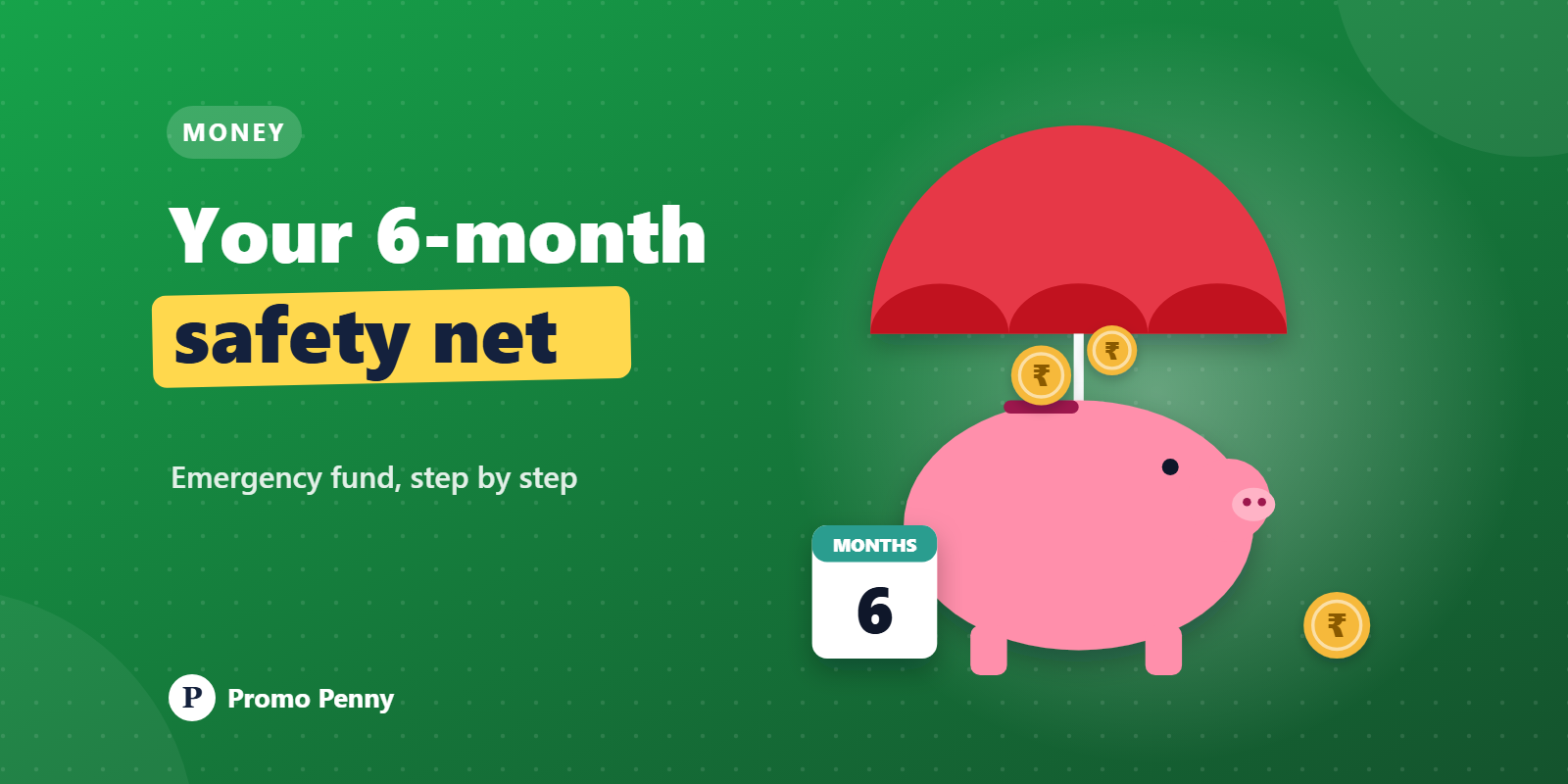
If your salary stopped tomorrow, how many months could you keep paying rent, EMIs, groceries and school fees without borrowing from anyone? That number, counted in months, is your emergency fund. For a lot of salaried people in India the honest answer is "about one", and that gap is what this guide is about.
An emergency fund is not an investment. Its job is to be boring, safe and reachable within a day, so that a layoff, a hospital bill or a sudden trip home does not push you into a personal loan or a credit card balance charging high interest.
The common rule of thumb is three to six months of essential expenses. Where you sit in that range depends on how steady your income is and how many people depend on it.
| Your situation | A sensible target |
|---|---|
| Salaried, stable employer, two earners in the household | 3 to 4 months |
| Salaried, single earner, or a job in a sector prone to layoffs | 6 months |
| Self-employed, freelancer, commission or business income | 6 to 12 months |
| Single income supporting children and ageing parents | 6 to 12 months |
Why the difference? A salaried person who loses a job usually gets some notice pay. A freelancer or shop owner can have three slow months in a row with no warning and no severance cheque. Single-income families have no second salary to lean on. If that's you, aim for the higher end.
One more thing: an emergency fund does not replace health insurance or term insurance. A single hospital stay can wipe out six months of savings. Get the insurance in place, then build the fund to cover what insurance doesn't.
Count what you would still have to pay if life got tight. Not your current spending, your survival spending.
Leave out SIPs (you can pause them), eating out, shopping, OTT subscriptions and holidays. Those are real costs in normal life, but in an emergency you would cut them first, so they don't belong in the target.
The money has to be safe and quick to reach. Returns come third.
Instant access through UPI, ATM or net banking, any day of the week. The interest is low, often below inflation. Deposits are insured by the DICGC up to ₹5 lakh per depositor per bank, covering principal and interest together. The real risk is you: money sitting next to your daily spending gets spent. A separate account helps.
Many banks let you set a threshold on a savings account. Anything above it is automatically moved into fixed deposits, and when you need cash, the bank breaks those deposits (usually in small units) and moves money back. You get FD-like interest on the parked amount with near-instant access. The catches: the broken portion may earn a lower rate for the time it was held, the interest is taxed at your slab rate, and each bank's rules on threshold, unit size and which deposit gets broken first are different. Read your bank's terms before relying on it.
A liquid fund is a debt mutual fund that invests in very short-term instruments such as treasury bills and commercial paper maturing within about three months. Returns have usually been close to short-term interest rates, but they are not guaranteed and not covered by DICGC insurance. A normal redemption typically reaches your bank on the next working day. Many funds offer instant redemption, but only up to a small capped amount per day, and there is a small exit load if you withdraw within the first week. Under current rules, gains on debt funds bought after April 2023 are taxed at your slab rate. Tax rules change, so check the latest position before you decide.
| Option | Access | Returns | Main trade-off |
|---|---|---|---|
| Savings account | Instant, 24x7 | Lowest | Easy to spend by accident |
| Sweep-in FD | Instant to same day | Close to FD rates | Bank-specific rules on breaking |
| Liquid fund | Usually next working day | Close to short-term rates, not fixed | Market-linked, not insured |
What does not belong here: stocks and equity funds (they tend to fall in the same downturn that costs people jobs), gold, PPF with its lock-in, or crypto.
Take a hypothetical person in Pune with a take-home salary of ₹50,000. Their essential monthly costs look like this: rent ₹15,000, groceries and utilities ₹9,000, commute ₹3,000, phone and internet ₹1,000, money sent home ₹4,000, insurance premiums worked out to ₹1,000 a month. That's ₹33,000.
Six months of that is about ₹2 lakh. If they can set aside ₹10,000 a month, it takes around 20 months. That sounds slow, so break it into stages:
Set an automatic transfer for salary day, so the saving happens before you see the money. Putting part of a bonus straight in can cut months off. Some people split their ₹10,000 between the emergency fund and a small SIP; there's no single right answer, but getting the first three months in place before taking investment risk is a reasonable order of priority.
A quick test: is it necessary, is it urgent, and was it unexpected? If all three are yes, use the fund without guilt. That is what it is for.
Using the fund is not a failure. Leaving it empty is. Once the emergency is over, go back to the same monthly transfer, and pause discretionary extras until the balance is back to target.
Revisit the target once a year, or when life changes: marriage, a child, a new home loan, a move to freelancing. Expenses rise with inflation, so an old target is probably short today.
This article is general education, not personal financial advice. Interest rates, insurance limits and tax rules change, so check your bank, fund house or a qualified adviser before deciding.

























© 2026 Promo Penny. All rights reserved
Designed & Developed by IngeniousPro Team.