The ball thuds into the pad, eleven fielders go up together, and the umpire has a second or two to decide. Was it in line? Would it have hit? Did it touch the bat first? Then comes the review, the replay, the ball-tracking graphic, and quite often the words umpire's call, which leave half the stadium happy and the other half furious.
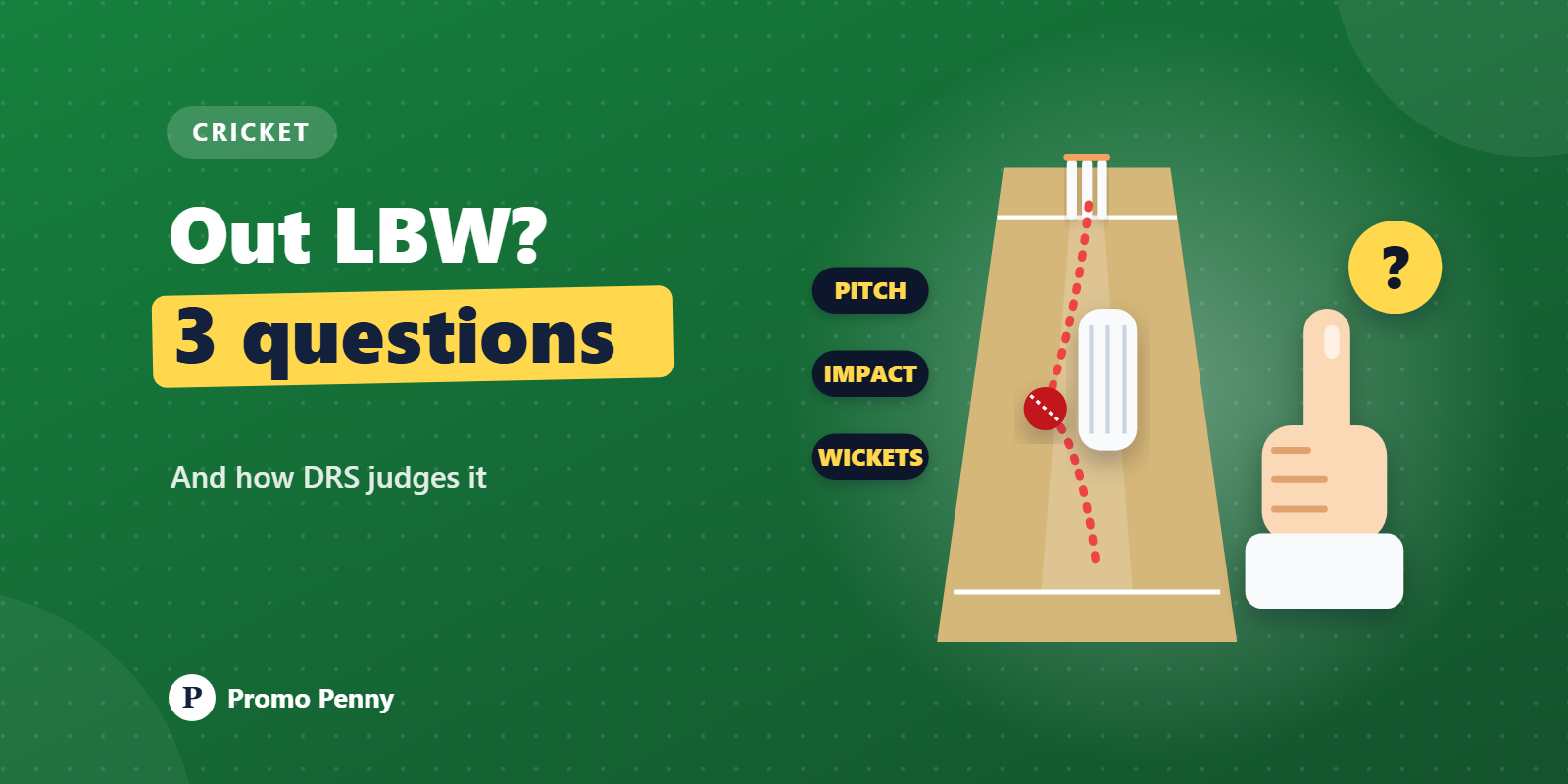
Leg before wicket, or LBW, sounds complicated, but the law that governs it is really a checklist. If every box is ticked, it's out. If even one isn't, it's not out. Learn the boxes and the drama makes a lot more sense.
LBW is covered by Law 36 of the Laws of Cricket, which are written and maintained by the MCC. For the batter to be out, all of these must be true:
Off side and leg side depend on the batter's stance. The off side is the side the batter faces when taking guard, and the leg side is the side behind their legs. For a left-hander, everything flips compared with a right-hander.
The two zones either side of the stumps are treated very differently, and this is where most confusion comes from.
Outside leg stump is protected. If the ball pitches outside leg, it's not out, however straight it then turns. If the impact is outside leg, it's also not out. The reason is old and practical: batters can't easily protect their legs from balls angled in from that side, and the law doesn't want bowlers simply aiming at the pads.
Outside off stump depends on what the batter did. A ball can pitch outside off and still be LBW, as long as the other conditions are met. The impact, though, is where the exception comes in:
This is the no-shot rule. It exists to stop batters from simply kicking away every ball outside off with their pads. Picture an off-spinner bowling to a right-hander. The ball lands outside off, the batter thrusts his front pad forward with his bat tucked behind it, and the ball spins back towards middle stump. No shot, so the fact that the impact was outside off doesn't save him.
Judging whether a shot was genuine is the umpire's call in the everyday sense. A bat held well away from the ball, purely for show, may not be accepted as a real attempt.
This is the part that asks the umpire to see the future. They have to consider the line of the ball, how much it was turning or swinging, how high it was bouncing, and how far it still had to travel. A ball that hits the pad just in front of the stumps leaves little room for doubt. A ball that hits the batter far down the pitch, after a big stride forward, leaves a lot.
Height matters as much as line. A short ball striking the thigh may be heading over the stumps, especially on a bouncy pitch. That's why umpires are often cautious when the batter is struck high or a long way forward.
Under the Decision Review System, a team can ask the third umpire to look again at an on-field decision. For LBW, the third umpire works through the same checklist, roughly in this order:
The pitching result is shown as in line, outside off or outside leg. The impact and wickets results can also come back as umpire's call.
Ball-tracking measures the real path up to impact, but everything after that is a projection, and projections carry some uncertainty. Rather than pretend the technology is perfect, DRS keeps a margin around the edges where the on-field decision stands.
Here's how it works for the wickets check:
The impact check works the same way for balls hitting the pad right on the edge of the in-line zone. The ICC has adjusted the size of these zones over the years, so its current playing conditions are the official source for the exact definitions.
So the same delivery, tracked to clip the top of off stump, can be out in one match and not out in another, depending only on what the on-field umpire said first. It feels unfair, but it is deliberate. Umpire's call gives the benefit of the doubt to the person who saw it live, and saves overturns for clear errors.
Under ICC playing conditions for international matches, a review that ends in umpire's call is not counted as a lost review. The number of reviews allowed, and whether DRS is used at all, varies by format and tournament, so check the event's playing conditions.
The one thing to remember: LBW is out only if every condition is met, and DRS exists to fix clear mistakes, not to second-guess the close ones.
























© 2026 Promo Penny. All rights reserved
Designed & Developed by IngeniousPro Team.