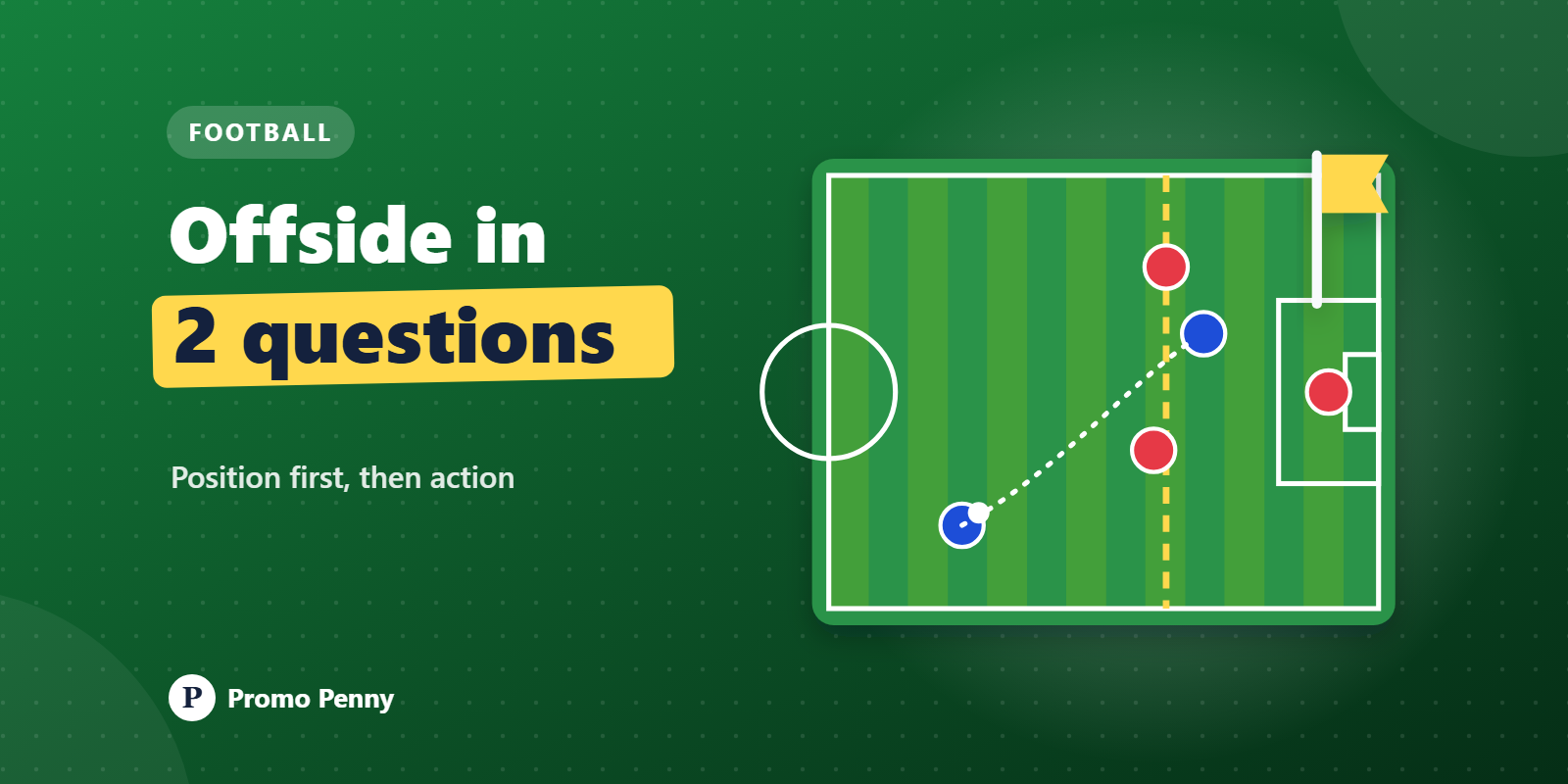
Here is the offside rule in one breath. At the moment a teammate plays the ball to you, if you are in the opponents' half and closer to their goal line than both the ball and the second-last defender, you are in an offside position. You are only penalised if you then get involved in play.
Almost every argument about offside comes from blurring those two parts together. So take them one at a time: first where you were, then what you did. The rule lives in Law 11 of the Laws of the Game, written by IFAB, the body that sets football's rules worldwide. It gets small clarifications from time to time, so the current IFAB text is the final word.
All of these must be true at the instant your teammate plays or touches the ball:
Why second-last? Because the goalkeeper is usually the last opponent, so the second-last is normally the deepest outfield defender. Not always, though. If the keeper has charged out and two defenders are standing on the goal line, one of those defenders is the second-last opponent and the keeper doesn't come into it.
Notice the timing. What matters is where you are when the ball is played, not where you are when you receive it. A striker who is level when the pass is hit and then sprints five metres clear of the defence is perfectly fine.
If you are level with the second-last opponent, you are not in an offside position. Level with the last two opponents: also fine. Level with the ball, or behind it: fine.
That last point explains the cut-back. A winger who reaches the byline and pulls the ball back to a teammate arriving behind him can't put that teammate offside, because the receiver is behind the ball when it is played, however many defenders are out of position.
Head, body and feet count. Hands and arms do not, for any player, goalkeepers included. The law sets the top of the arm at the bottom of the armpit. So a shoulder counts, but an outstretched arm pointing towards goal does not.
The logic is neat: you can only be offside with a part of your body you are allowed to score with.
Being in an offside position is not an offence on its own. You are only penalised if you become involved in active play in one of three ways.
Say a teammate shoots from 25 yards and scores. Your striker was standing in an offside position on the far side of the box, nowhere near the ball or the keeper's view. No offence, goal stands. Now move that same striker so he is standing right in front of the keeper as the shot goes in. He is blocking the keeper's line of vision, so the goal is ruled out.
The punishment is an indirect free kick to the defending team, taken from where the offence happened.
Suppose an attacker is in an offside position when his teammate passes. A defender gets to the ball first. What happens if it then falls to the attacker?
It depends on how the defender touched it.
IFAB has added guidance on what counts as deliberate play. Officials consider things like whether the defender had time to react, whether he could see the ball coming, and whether he was balanced and in control. A desperate stretch at a fast ball looks more like a deflection than a deliberate play. It is still a judgement call.
There is no offside offence if you receive the ball directly from:
Free kicks are not on the list, which is why you see defensive lines step up just before a free kick is taken. You also can't be in an offside position in your own half, as covered above.
One sneaky trick is closed off too. A defender who walks off the pitch without the referee's permission to try to leave an attacker offside is treated as standing on his own goal line or touchline until the next stoppage.
Close offside calls are now often reviewed by VAR, and the process explains the odd-looking pictures on TV.
First, the assistant referee will often keep the flag down on a tight call and let the move finish. If the flag goes up and play stops, a wrongly disallowed goal can't be rescued. If play continues, VAR can still rule it out.
Second, VAR has to pick the exact moment the ball was played. Broadcast cameras record a fixed number of frames per second, and the true moment of the kick can fall between two frames. A sprinting player moves a noticeable distance between frames, so the frame choice alone can matter on very close calls.
Third, lines are drawn parallel to the goal line from the attacker's furthest-forward part that counts and from the second-last defender's. Because the camera views the pitch at an angle, those parallel lines look slanted on your screen. That is perspective, not a mistake.
Some competitions use semi-automated offside technology, which tracks players' limbs with multiple cameras and builds the 3D animation you sometimes see. Either way, the law itself has no margin: a toe is either ahead or it isn't. Whether football should add a tolerance for tiny margins is an ongoing debate, not settled law.
Next time a goal is flagged, run through this:
If you answer those in that order, you will get most offside calls right before the replay finishes.



























© 2026 Promo Penny. All rights reserved
Designed & Developed by IngeniousPro Team.