Stroke Signs (BE FAST) and What to Do Before Help Arrives
Your father is reading the newspaper and suddenly can't hold it up. One side of his mouth droops, and when he tries to say he's fine, the words come out slurred. It might pass in a few minutes. It might not. Either way, what happens in the next hour can decide how he lives for years.
A stroke is an emergency, and many of the treatments that limit its damage only work if they start within hours. Here's how to recognise one, and what to do, and not do, while help is on the way.
What a stroke is
A stroke happens when part of the brain suddenly stops getting enough blood. Most often, a clot blocks an artery that supplies the brain; this is an ischaemic stroke. Less often, a blood vessel in or around the brain bursts and bleeds; this is a haemorrhagic stroke.
From the outside, the two can look identical. Inside, they need opposite handling: one needs the clot dissolved or removed, the other must not be given anything that thins the blood. Only a brain scan can tell them apart, and that single fact shapes almost all the advice below.
Recognise it: BE FAST
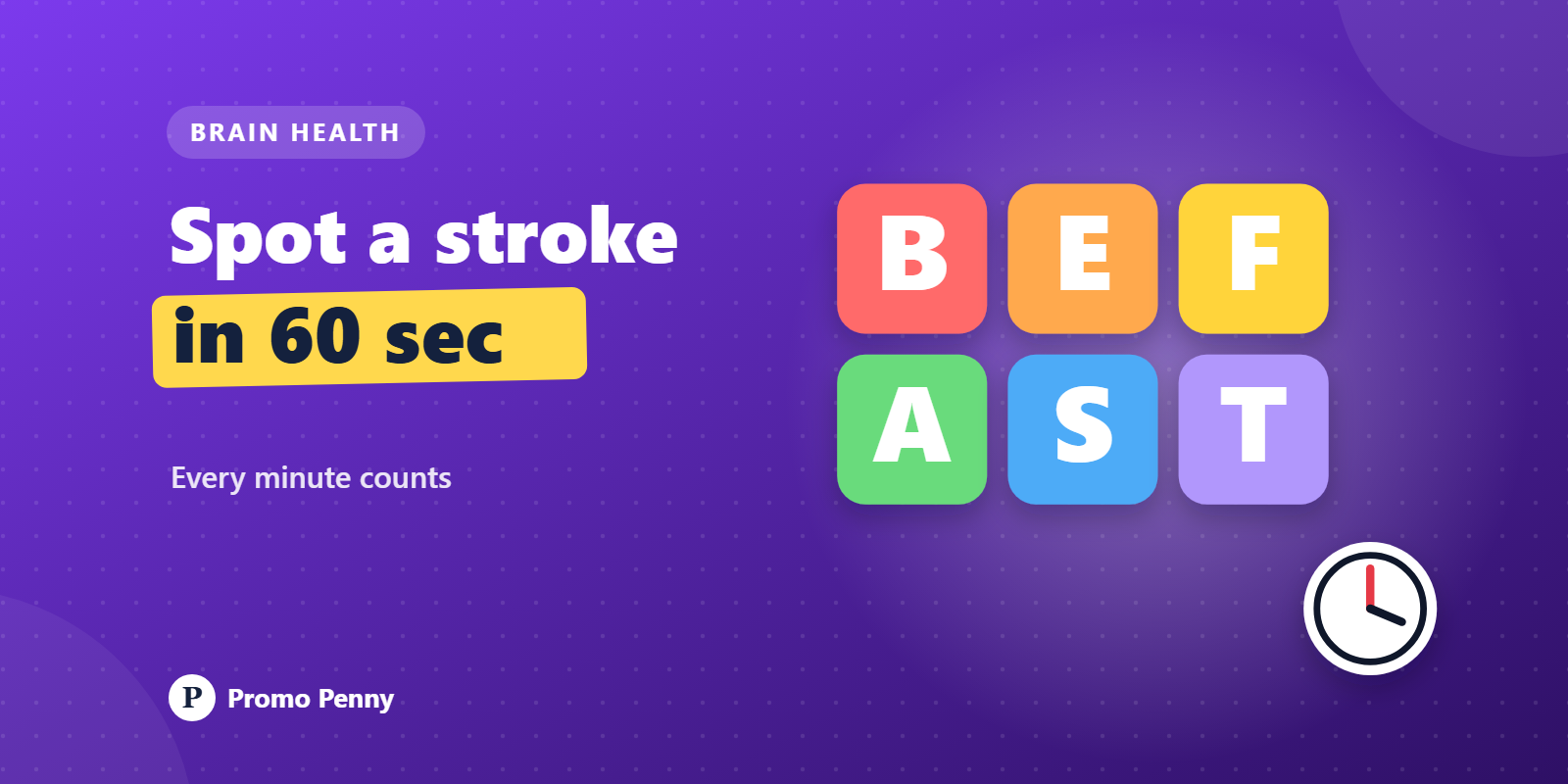
Stroke symptoms come on suddenly, within seconds or minutes. The memory aid used by doctors and paramedics is BE FAST:
- B for Balance: sudden loss of balance, dizziness or trouble walking.
- E for Eyes: sudden blurred or double vision, or loss of vision in one or both eyes.
- F for Face: one side of the face droops. Ask the person to smile and look for an uneven smile.
- A for Arm: weakness or numbness in an arm or leg, usually on one side. Ask them to raise both arms; one may drift down.
- S for Speech: slurred speech, trouble finding words or understanding what's said. Ask them to repeat a simple sentence.
- T for Time: note the time and call for help at once.
A sudden, severe headache unlike any before can signal bleeding in the brain and needs emergency care too. You don't need every sign. One sudden sign is enough to act.
Why time matters so much
Doctors have a phrase for this: time is brain. When an artery is blocked, the brain tissue it feeds starts dying within minutes, and in a major stroke the loss runs to millions of nerve cells every minute. Around the dead core there's a zone of struggling tissue that can still be saved if blood flow returns quickly.
Two main treatments do that for clot strokes:
- Clot-busting medicine (thrombolysis), given into a vein. It generally has to start within about 4.5 hours of the time symptoms began, and the earlier within that window, the better it works.
- Mechanical thrombectomy, where a specialist threads a thin tube through an artery up to the brain and pulls out a large clot. Fewer, larger hospitals offer it. It works best within the first six hours, and in carefully selected patients it can help up to about 24 hours.
Both need a CT or MRI scan first to rule out bleeding. So the clock that counts isn't when you reach a hospital; it's when the scan is done and treatment begins. Every stop at a place that can't do the scan uses up time you don't get back.
What to do while help is coming
Do this
- Call 108 or 112 for an ambulance and say clearly that you suspect a stroke. If an ambulance will take long and you can move the person safely, go yourself.
- Note the time symptoms started. Look at a clock and write it down. If the person woke up with symptoms or was found like this, note the last time they were seen normal. Doctors use this to decide which treatments are still possible.
- Head for a hospital that can treat stroke: one with a CT scanner working round the clock and doctors who can give clot-busting treatment. Many large government and private hospitals in Indian cities can do this. Find out now which one is closest to your home and your parents' home, before you ever need it. A small clinic without a scanner can't treat a stroke; it can only send you onward.
- Keep the person safe. Help them lie down with the head and shoulders slightly raised. If they're drowsy or vomiting, turn them on their side so they don't choke. Loosen tight clothing and stay with them.
- Gather information: their medicine list, especially any blood thinners, and recent medical reports. Ask a relative to bring these if you're leaving in a hurry.
Avoid this
- Don't give food, water or tea. A stroke can affect swallowing, and liquid can slip into the lungs. Nothing by mouth until a doctor has checked.
- Don't give aspirin unless a doctor tells you to. If this stroke turns out to be a bleed, aspirin can make it worse. Doctors give it, if it's needed, after the scan.
- Don't give extra BP tablets or home remedies. Dropping blood pressure sharply during a stroke can do harm; hospitals manage it carefully.
- Don't wait to see if it passes, and don't let the person sleep it off.
- Don't stop at a nearby clinic for a first opinion if a stroke-ready hospital is within reach.
When symptoms vanish: the TIA warning
Sometimes the drooping face or weak arm goes back to normal within minutes and everyone relaxes. This may have been a transient ischaemic attack (TIA), often called a mini-stroke, where a clot blocks blood flow briefly and then clears.
A TIA leaves no lasting damage, but it's a loud warning. The risk of a full stroke is highest in the days right after a TIA, especially the first two. Treat it like a stroke and get to a hospital the same day. Tests often find the cause, such as a narrowed artery in the neck or an irregular heartbeat, and treating it can prevent the big one.
Risk factors you can act on
Age and family history raise stroke risk, and you can't change those. Much of the rest you can:
- High blood pressure is the single biggest risk factor, and many people in India have it without knowing. Get it checked and keep it controlled.
- Diabetes and high cholesterol damage arteries over time.
- Smoking, chewing tobacco and heavy drinking.
- Atrial fibrillation, an irregular heartbeat that lets clots form in the heart and travel to the brain. An irregular pulse is worth reporting to a doctor; treatment greatly lowers the stroke risk it brings.
- Excess weight, too little physical activity and a lot of salt in the diet.
- A previous stroke or TIA.
Do this today
- Learn BE FAST and teach it to everyone at home, including older children and anyone who looks after elderly relatives.
- Find the nearest hospital with a 24-hour CT scanner and stroke treatment, and save its number in your phone.
- Keep an up-to-date medicine list for older family members where anyone can find it.
- Remember the sequence: sudden sign, note the time, call 108 or 112, nothing by mouth.
This article is general information, not medical advice. If you suspect a stroke, call 108 or 112 straight away; for questions about your own risk, talk to a doctor.