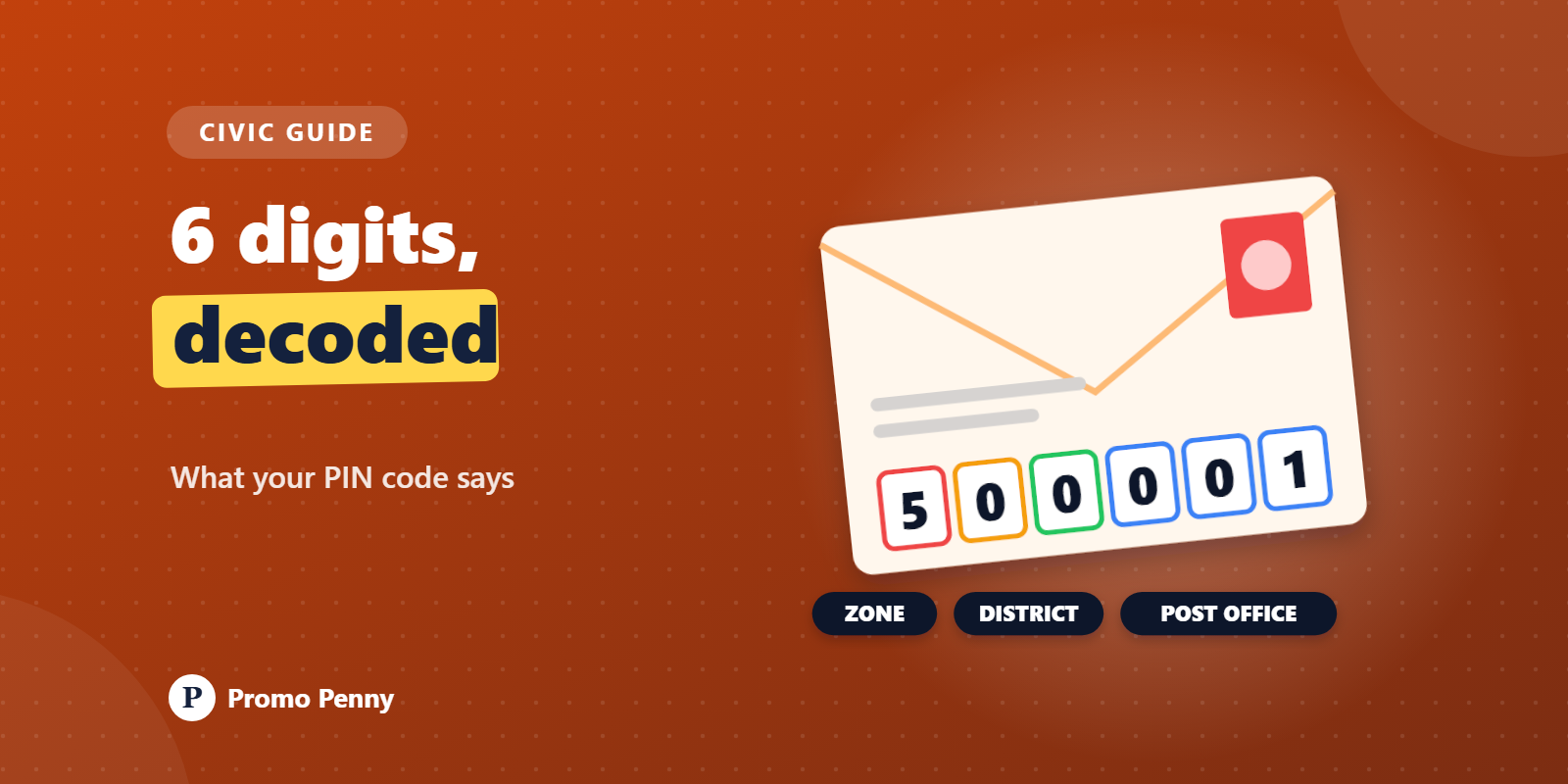
Take a PIN code like 560001. It looks like a random six-digit number, but it is really an address written in shorthand. The first digit tells a sorting office which part of the country the item is going to. Each digit after that narrows it down, until the last three point to one particular delivery post office.
PIN stands for Postal Index Number. India Post introduced it on 15 August 1972, at a time when sorters had to deal with huge volumes of mail and thousands of place names, many of which repeat across states or are spelt several ways. Shriram Bhikaji Velankar, a senior official in the postal department, is generally credited with devising the system.
India is divided into nine PIN zones. Eight are geographic, and the ninth is reserved for the Army Postal Service.
| First digit | Region covered |
|---|---|
| 1 | Delhi, Haryana, Punjab, Himachal Pradesh, Jammu and Kashmir, Ladakh, Chandigarh |
| 2 | Uttar Pradesh, Uttarakhand |
| 3 | Rajasthan, Gujarat, Dadra and Nagar Haveli and Daman and Diu |
| 4 | Maharashtra, Goa, Madhya Pradesh, Chhattisgarh |
| 5 | Andhra Pradesh, Telangana, Karnataka |
| 6 | Tamil Nadu, Kerala, Puducherry, Lakshadweep |
| 7 | West Bengal, Odisha, the North-Eastern states including Sikkim, Andaman and Nicobar Islands |
| 8 | Bihar, Jharkhand |
| 9 | Army Postal Service (field post offices) |
So a parcel with a PIN starting with 6 is headed to the far south, and one starting with 2 is going to Uttar Pradesh or Uttarakhand. That one digit already tells a big sorting hub which direction to send it.
The zones follow postal administration, which mostly but not always lines up with state borders. Yanam, part of the Union Territory of Puducherry, sits inside Andhra Pradesh on the map and has a PIN starting with 5, not 6. Quirks like this are why you should look up a PIN rather than guess it from the state.
Add the second digit and you get a sub-zone, which broadly corresponds to a postal circle. India Post organises its work into circles, and a circle is usually one state, though some cover a state plus neighbouring territories. A big state can have several two-digit codes of its own.
Take the south as an example. Telangana PINs start with 50. Andhra Pradesh PINs start with 51, 52 or 53. Karnataka uses 56 through 59. All of them sit in zone 5, but the second digit already separates them.
The first three digits together identify a sorting district, the area handled by one main sorting office. Big cities usually have their own. Most Delhi PINs begin with 110, Mumbai's with 400, Chennai's with 600, Kolkata's with 700, Bengaluru's with 560 and Hyderabad's with 500.
A sorting district is a postal unit, not the same as a revenue district. One revenue district can be split across more than one sorting district, and the boundaries don't always match the ones on a district map.
Once a letter reaches the right sorting office, the first three digits have done their job. The rest is about the last few kilometres.
The final three digits point to the specific post office that will deliver the item, the one whose postman actually comes to your door. In many cities, the code ending in 001 belongs to the main post office, such as the GPO, and others are numbered from there. A large city has dozens of delivery offices, each with its own PIN.
Small branch post offices in villages usually share the PIN of the post office they report to. That's why several villages, or several colonies in a town, can have the same PIN, while one large neighbourhood can be split between two.
Here is how a sorter would read 560001:
Now imagine you type it as 506001 by mistake. A code starting with 50 belongs to Telangana, not Karnataka, so the parcel is sent to a Telangana sorting office instead. One swapped pair of digits, and your parcel heads hundreds of kilometres in the wrong direction before anyone notices.
Sorting leans heavily on the PIN. At each stage, mail and parcels are bagged and routed by it, often by staff working fast or by sorting machines in larger centres. A wrong PIN doesn't just slow down the last step. It can send the item to the wrong sorting office entirely, where someone has to spot the mismatch with the written address and push it back into the system.
Couriers and online shops depend on PIN codes even more. When you enter your PIN at checkout, the site uses it to decide whether it delivers to you at all, how long delivery will take, whether cash on delivery is available and which hub your order goes to. With a wrong PIN, a parcel can sit at a hub that doesn't serve your street, or the order can be marked undeliverable and returned.
Common ways people end up with the wrong PIN:
Post office names, branch arrangements and occasionally PINs do change as cities grow and new offices open. For anything important, such as a passport application, a bank KYC form or a government certificate, confirm the PIN on India Post's official search rather than a random website.
One small habit makes a real difference: when you write an address, put the PIN clearly on its own at the end and read it back once, digit by digit. It takes three seconds and can save you days.































© 2026 Promo Penny. All rights reserved
Designed & Developed by IngeniousPro Team.