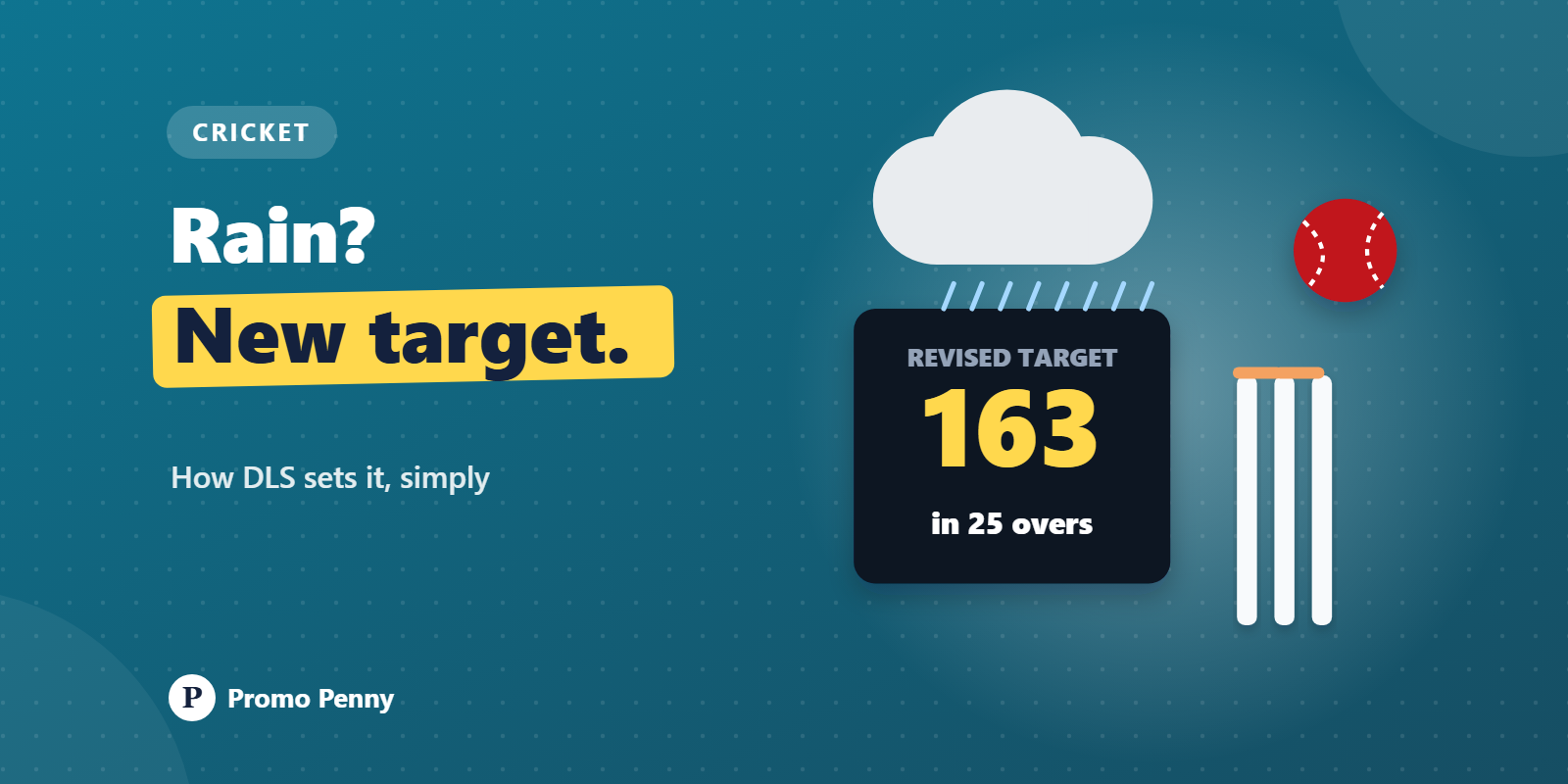
Rain stops play. When the covers come off, the scoreboard says the chasing side now needs a number that seems to come from nowhere, and half your WhatsApp group is sure it's unfair. That number comes from the Duckworth-Lewis-Stern method, or DLS, and the idea behind it is simpler than the maths.
DLS treats a batting side's innings as a stock of resources: overs left and wickets in hand. Lose either and you've used some up. Targets are adjusted by comparing how much of that stock each side actually had.
It sounds fair. Team A makes 250 in 50 overs, that's five an over, so if Team B only gets 25 overs, set them 126.
The problem is wickets. Team A had to pace 250 across 50 overs with ten wickets, keeping something in reserve for the death overs. Team B gets 25 overs with all ten wickets. They can swing from the first ball, because running out of wickets in 25 overs is far less likely. Scoring 125 in 25 overs with ten wickets to spare is much easier than scoring 250 in 50.
Older rain rules got this wrong in both directions. The average run rate method favoured the chasing side, for the reason above. The "most productive overs" method, which dropped the chasing side's target by the runs Team A scored in its weakest overs, went the other way and could leave a chase almost impossible. It produced one of cricket's most famous absurdities in a 1992 World Cup semi-final, when South Africa's gettable target against England was revised to an impossible equation off a single ball.
At the start of an innings, a side has 100 percent of its resources. Every ball bowled uses some. Every wicket lost uses some too.
The key insight is that the two interact. Losing a wicket in the fifth over is expensive, because that batter would have been valuable over the many overs still to come. Losing a wicket in the 49th over barely matters, because there is almost no time left to use him. Likewise, ten overs left with eight wickets in hand is worth far more than ten overs left with two wickets in hand.
DLS turns this into a table, now built into software, drawn from the scoring patterns of a huge number of real matches. For any combination of overs left and wickets lost, it gives the percentage of resources remaining.
The basic rule then follows. If Team B has fewer resources than Team A had, Team B's par score is Team A's score multiplied by Team B's resources divided by Team A's. The target is par plus one.
The percentages below are illustrative only, chosen to keep the maths easy. They are not real DLS table values.
Team A scores 250 in a full 50 overs, using 100 percent of its resources. Before Team B starts, rain cuts their innings to 25 overs.
Suppose 25 overs with all ten wickets is worth 65 percent of a full innings. Not 50 percent, because those wickets let Team B attack harder.
Compare that with the 126 you'd get by simply halving. That gap is the value of the wickets that simple scaling ignores.
During a chase on a cloudy day, TV channels show a par score. It is the score the chasing side needs at that moment to be exactly level if no more play were possible. Ahead of par, they win if it rains for good. Behind par, they lose.
Par depends heavily on wickets. Using illustrative numbers again, imagine Team B chasing 250 is 100 runs into its innings after 20 overs.
| Situation after 20 overs | Resources used (illustrative) | Par score | If play stops now |
|---|---|---|---|
| 100 for 2 | 35% | 87 | Team B wins |
| 100 for 6 | 60% | 150 | Team B loses |
Same runs, same overs, opposite results. The side six down has burned through far more of its resources, so it should have scored many more runs by now to be on level terms.
The same logic applies when an interruption shortens a chase that is already under way. Say rain removes 10 overs when Team B is at 100 for 2 after 20. With eight wickets in hand, those lost overs were valuable, so Team B loses a big slice of resources, perhaps 15 percent in our made-up table, leaving 85 percent overall. Revised target: 250 x 0.85 = 212.5, so par 212 and target 213, needing 113 more from 20 overs.
Had Team B been 100 for 6 instead, those same 10 overs would have been worth less to them, because four wickets can't make full use of them. The reduction would be smaller, and they would need more runs from their remaining 20 overs. Captains know this, which is why a chasing side with rain on the radar often bats to stay ahead of par rather than to the full-length chase.
DLS also works the other way. If Team A's innings is interrupted, its batters didn't know they would lose overs, so they may have paced for a full 50 and never got to the final slog. In that case Team B can be set a target higher than Team A's actual score. That reflects the fact that Team A was denied the overs where runs come fastest.
The method was devised by two English statisticians, Frank Duckworth and Tony Lewis, and was adopted in international cricket in the late 1990s. Over time it moved from a printed table to a computer-based Professional Edition used in top matches.
As scoring rates rose, with bigger one-day totals and the influence of T20 batting, the original resource values began to look dated, especially in high-scoring games. The Australian statistician Steven Stern took over as custodian of the method and updated it, and it was renamed Duckworth-Lewis-Stern in the mid-2010s. In broad terms, his changes refreshed the resource values with modern data and improved how targets behave when totals are high, reflecting how today's teams accelerate in the later overs. The core idea of resources stayed the same.
The ICC reviews the method from time to time. The ICC's playing conditions are the official source for the current version.
DLS can only decide a match if enough cricket has been played. Under the standard ICC playing conditions:
If the chasing side has already reached its target, or a side has been bowled out, that settles things too. Otherwise, below the minimum, the match is a no result. Some tournaments set higher minimums for knockout games or use reserve days, so check the event's playing conditions.
The one thing to remember: in DLS, a wicket is a resource just like an over. Keep wickets in hand and the rain is on your side.
































© 2026 Promo Penny. All rights reserved
Designed & Developed by IngeniousPro Team.