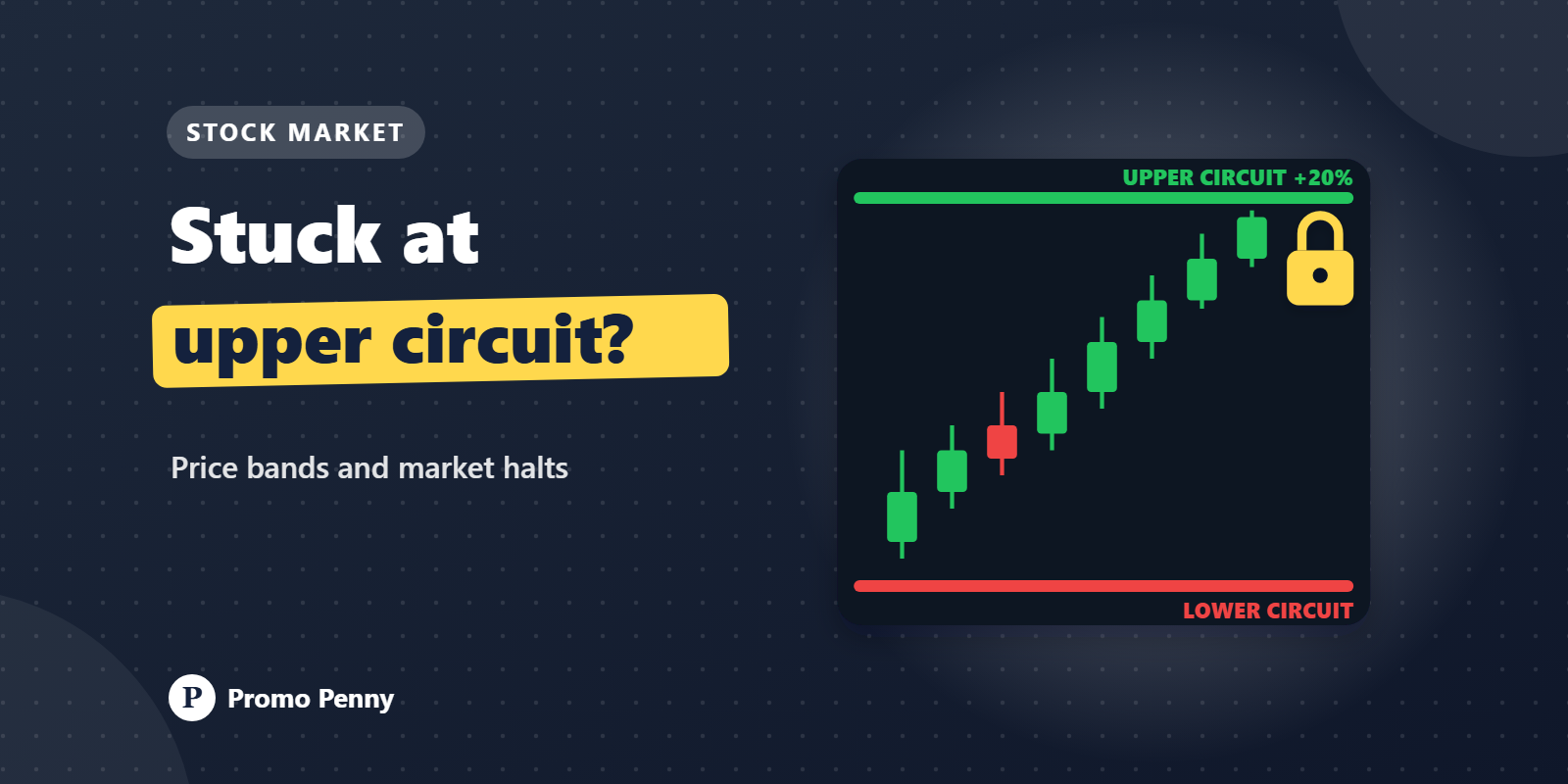
You open your trading app and a small-cap stock is up 20% with "UC" next to it. The sell side of the order book is empty, the buy side shows lakhs of shares waiting, and the buy order you place sits there pending all day. Nothing is broken. The stock has hit its upper circuit.
Circuits are the exchange's speed limits. They exist at two levels: for individual stocks, and for the market as a whole. Here is how both work, and what they mean for an ordinary investor.
For most stocks, NSE and BSE set a daily price band: the furthest the price is allowed to move from the previous day's close in a single session. Common bands are 2%, 5%, 10% and 20%.
Say a stock closed at ₹100 yesterday and has a 10% band. Today it can trade anywhere between ₹90 and ₹110, and nowhere else. ₹110 is its upper circuit; ₹90 is its lower circuit. Tomorrow, the band is recalculated from tomorrow's base price.
Exchanges decide which band a stock gets and revise it from time to time. Thinly traded, very volatile stocks, or those under surveillance, tend to get narrower bands such as 5% or 2%. The exact percentages, who gets what and the rules behind them are set by the exchanges under SEBI's framework, and they change. NSE and BSE publish the current band for every stock on their websites.
Imagine good news hits our ₹100 stock. Buyers rush in. The price climbs to ₹110 and can't go higher today. Now everyone who wants the stock is bidding ₹110, but anyone holding it thinks it is worth more, so almost nobody sells at ₹110.
Result: a huge queue of buy orders at the top price and no sellers. Trading slows to a trickle or stops. The stock is "locked" at upper circuit. If the enthusiasm continues, the same thing happens tomorrow at ₹121, and so on, which is how some small companies post a long run of upper circuits.
The lower circuit is the mirror image, and it is the one that hurts. A stock locked at lower circuit has a long queue of sellers and nobody buying. If you hold it, you may not be able to exit at any price for days. That is a liquidity trap, and it is why "my stock is falling but I'll sell if it gets bad" is not a plan for illiquid small caps.
A run of circuits in a tiny, little-known company is also a pattern seen in pump-and-dump schemes, where operators push a price up with tips on social media and then sell to the people who arrive late. Not every circuit is manipulation, but enough are that it deserves suspicion, not excitement.
Some stocks are also moved into the trade-for-trade segment, where every trade must be settled by delivery and you can't buy and sell the same day for intraday profit. Stocks under the exchanges' surveillance frameworks may carry extra margins and restrictions. Your app usually shows these labels; read them.
Stocks that have futures and options trading on them generally don't have fixed daily price bands. Instead, the exchanges apply dynamic price bands, sometimes called operating ranges. A stock starts the day with a band, and if trading pushes against it, the exchange can widen it in steps after a short cooling-off period.
The reason is practical. Futures and options are priced off the underlying share. If the share froze at a fixed circuit while big news was still being absorbed, derivative prices would lose their anchor, hedgers couldn't hedge and arbitrage between the cash and derivatives markets would break. So these large, liquid stocks are allowed to keep discovering a price, with brakes instead of a wall. That's why an F&O stock can move 15% or more in a day on major news without "hitting a circuit" the way a small cap does.
Separate from individual stocks, there is an emergency brake for the whole market. It is linked to the two main indices, the Nifty 50 on NSE and the Sensex on BSE. If either moves sharply from the previous day's close, in either direction, trading halts across all stock exchanges in equities and equity derivatives at the same time.
Under the framework SEBI has used for many years, the trigger levels are 10%, 15% and 20%, and the length of the halt depends on how big the move is and what time of day it happens:
| Index move | Typical effect |
|---|---|
| 10% | A halt of under an hour if it happens early in the day, shorter later on, and no halt close to the market's close |
| 15% | A longer halt early in the day, and trading closed for the day if it happens late |
| 20% | Trading closed for the rest of the day, whenever it happens |
When trading resumes after a halt, it restarts with a short pre-open session so buyers and sellers can find a fair opening price instead of rushing in at once. Index-level halts are rare. One recent instance was in March 2020, when the Covid-19 crash triggered the 10% lower breaker. The exact time slots and halt durations are in SEBI's circulars and on the NSE and BSE websites; check them there rather than relying on any article, including this one.
The idea behind the halt is simple: panic feeds on itself. A pause gives people time to read the news, brokers time to collect margins and the system time to catch up.
The one thing to remember: in the stocks most likely to hit circuits, getting out is harder than getting in. Plan for the exit before you place the buy.
This article is for general education only and is not investment advice or a recommendation to buy or sell any security. Exchange rules, price bands and circuit breaker levels are set by NSE, BSE and SEBI and can change; check their official websites for the current position.






























© 2026 Promo Penny. All rights reserved
Designed & Developed by IngeniousPro Team.