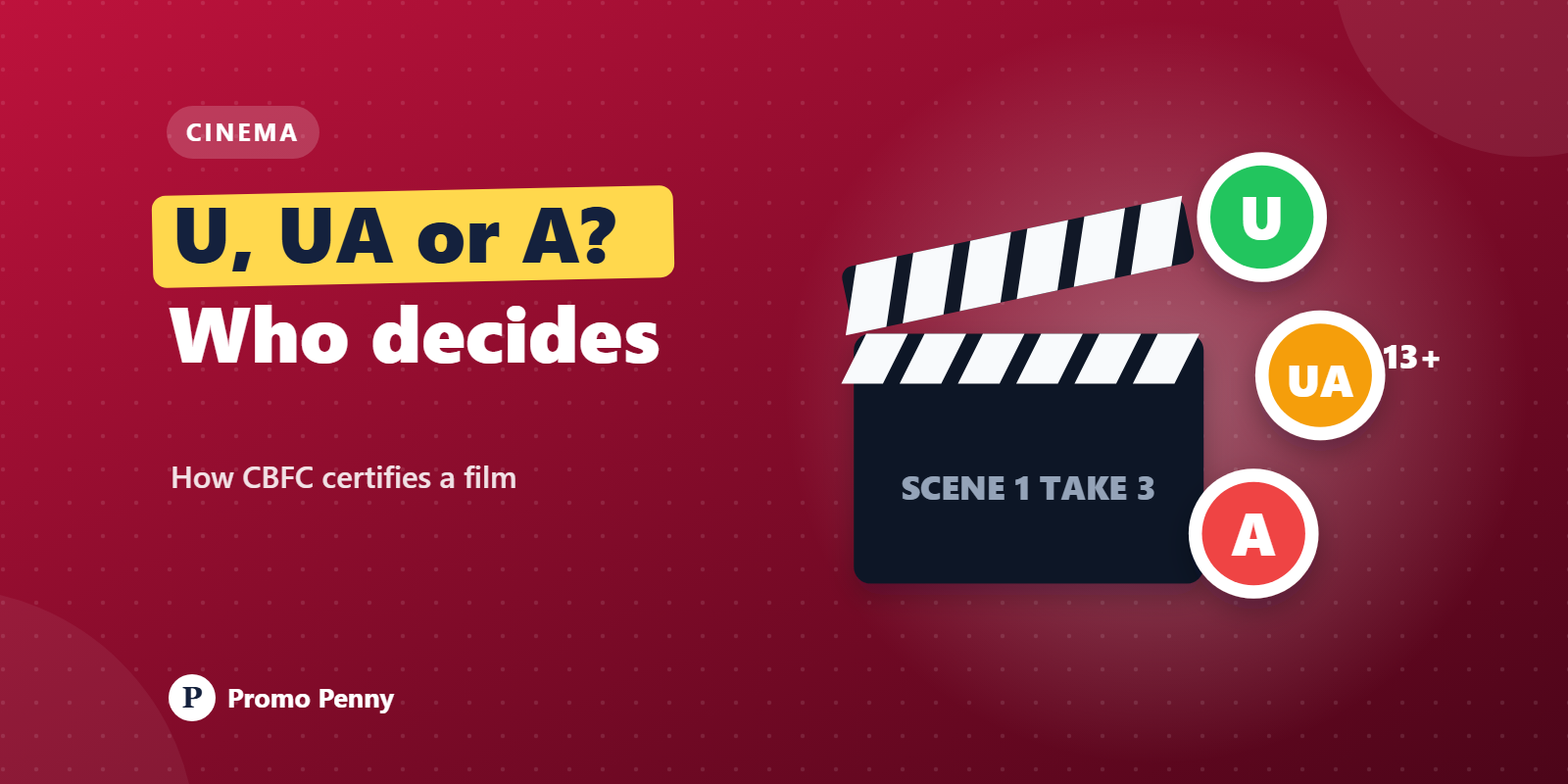
That card you see just before a film starts, with the category, the running time and a signature, is the reason the film is allowed to play in that hall at all. Every film shown publicly in an Indian cinema needs a certificate from the Central Board of Film Certification, the CBFC. Most people still call it the censor board.
The rating on that card is the end of a fairly structured process. Knowing how it works also explains why a film sometimes looks different on a streaming app than it did in the theatre.
The CBFC is a statutory body under the Ministry of Information and Broadcasting, set up under the Cinematograph Act, 1952. Its chairperson and board members are appointed by the central government. It is headquartered in Mumbai and works through regional offices in nine cities, with advisory panels of members drawn from the public who sit in on screenings.
Its job is to certify films for public exhibition, meaning screening in theatres. That covers trailers shown in cinemas too, not only full films.
Strictly speaking, the CBFC doesn't "ban" films. It can refuse to certify one, and without a certificate a film can't legally be shown in cinemas. The law lists the grounds on which a film, or part of one, can be refused: content against the sovereignty and integrity of India, the security of the state, friendly relations with foreign states, public order, decency or morality, or content that is defamatory, amounts to contempt of court or is likely to incite an offence. Detailed guidelines issued by the government sit under those broad grounds.
The Cinematograph (Amendment) Act, 2023 split the old UA category into age-based markers. The rules putting this into effect followed, so certificates now carry one of these:
| Category | What it means |
|---|---|
| U | Unrestricted public exhibition. Suitable for everyone. |
| UA 7+ | Unrestricted, but parental guidance advised for children below 7. |
| UA 13+ | Unrestricted, but parental guidance advised for children below 13. |
| UA 16+ | Unrestricted, but parental guidance advised for children below 16. |
| A | Restricted to adults, that is 18 and above. |
| S | Restricted to specialised audiences, such as doctors or scientists. |
The difference between UA and A matters more than people think. UA markers are guidance. A 10-year-old can legally watch a UA 13+ film; the marker tells parents it may have material they'd want to judge for themselves. An A certificate is a legal restriction, and theatres are expected to keep minors out.
The 2023 amendment changed a couple of other things worth knowing. Certificates no longer expire; the old ten-year validity was removed. And a film certified A or S can be edited and given a separate certificate for television or other media, which is how adult-rated films can reach TV in a trimmed form.
Here is the usual route for a feature film.
The rules set time limits for each stage, though in practice timelines become a talking point every time a big release is close to its date. Fees, forms and timelines are revised from time to time, so the CBFC's own website and the Ministry of Information and Broadcasting are the places to check the current version.
A certificate is often granted subject to changes. These come in two broad kinds.
Much of this is a negotiation over the category. A producer may accept a few trims to move from A down to UA 16+, because an A certificate keeps out families and teenagers and limits where the film can play later. Another producer may refuse cuts and accept the A, because the scenes matter more than the wider audience. Both are business decisions as much as creative ones.
Once a film is certified, the version shown in theatres is supposed to match the certified version. Adding material afterwards needs fresh certification.
Here is the part many viewers miss: the CBFC does not certify shows and films made for streaming platforms. Online content is covered by the Information Technology (Intermediary Guidelines and Digital Media Ethics Code) Rules, 2021, and works on self-classification.
Parts of the 2021 rules have been challenged in court, and some provisions have been put on hold, so this area is still settling.
This split explains a common puzzle. A film released in theatres carries a CBFC certificate for its theatrical version. When the same film later streams, the platform may show a different cut, sometimes with scenes that weren't in the cinema version. A film made directly for streaming may never go to the CBFC at all.
Television is different again. Broadcast rules generally don't allow content unsuitable for unrestricted viewing, which is why A-rated films usually reach TV only in an edited, recertified form.
Next time the certificate flashes up before a film, look for:
And if you're choosing for children, treat UA markers as advice to you, not a rule for them. You know your child better than any committee does.































© 2026 Promo Penny. All rights reserved
Designed & Developed by IngeniousPro Team.