A lipid profile report usually arrives as a single page: six or seven numbers, a column of reference ranges and, if you're unlucky, a few values in bold with an H beside them. Most people look for the bold ones, feel relieved or worried, and file the sheet away.
That wastes a useful test. Each number tells you something different, and the range printed next to it is often not the target your doctor has in mind for you. Here's how to read it properly.
Cholesterol and triglycerides are fats, and fats don't dissolve in blood. So the body packs them into particles called lipoproteins to carry them around. The test measures how much cholesterol is riding in different kinds of these particles, plus how much triglyceride is in your blood. Indian labs report the values in milligrams per decilitre (mg/dL).
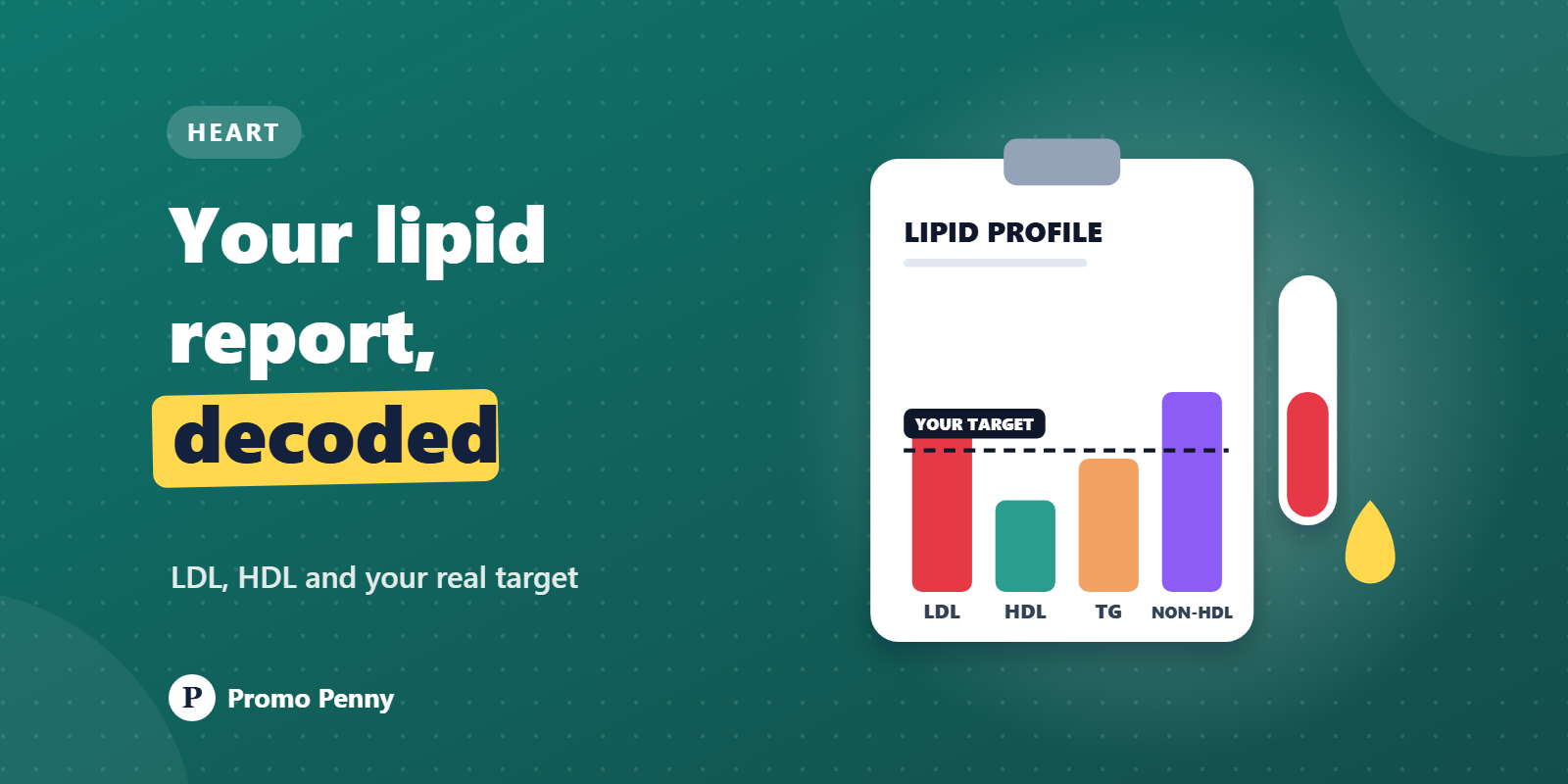
All the cholesterol in your blood, across every particle type. It's the oldest and bluntest number. A high total can come from a lot of harmful LDL or, less often, from a lot of HDL, so on its own it doesn't say much. Labs typically print below 200 mg/dL as desirable.
Low-density lipoprotein, the so-called bad cholesterol. LDL particles can lodge in artery walls and build the plaques that narrow arteries. This is the number doctors focus on most, and the one most treatment targets are written around.
On many reports LDL is calculated rather than measured. The classic method, the Friedewald formula, is: LDL = total cholesterol minus HDL minus (triglycerides divided by 5). It becomes unreliable when triglycerides are high, above about 400 mg/dL, or when LDL is very low, which is why some labs use newer formulas or measure LDL directly. The small print usually says 'calculated' or 'direct'.
High-density lipoprotein, the so-called good cholesterol, which helps carry cholesterol back to the liver. Low HDL, generally below 40 mg/dL in men and below 50 mg/dL in women, is linked with higher heart risk. But more isn't endlessly better. Very high HDL hasn't been shown to protect people, and medicines designed to raise HDL have largely failed to cut heart attacks in trials. Treat low HDL as a warning about your overall metabolism, not a number to chase on its own.
The form in which your body stores spare calories, especially calories from sugar, refined carbohydrates and alcohol. Below 150 mg/dL is usually called normal. Raised triglycerides often travel with a growing waistline, prediabetes or diabetes. Very high levels, in the high hundreds and beyond, also carry a risk of pancreatitis, a painful inflammation of the pancreas that needs urgent care.
Very-low-density lipoprotein. On most Indian reports this is simply triglycerides divided by 5, an estimate rather than a measurement. It adds little beyond the triglyceride figure, so there's no need to worry about it separately.
Total cholesterol minus HDL. It captures the cholesterol in every particle that can harm arteries, LDL, VLDL and others, in a single number. It's especially useful when triglycerides are high and calculated LDL turns shaky, and it barely depends on whether you fasted. Many doctors now give it as much weight as LDL. A common rule of thumb is that your non-HDL target is about 30 mg/dL above your LDL target.
Say a report (hypothetically) shows total cholesterol 210, HDL 40 and triglycerides 150.
The lab might flag only the total cholesterol as slightly high and mark the LDL as borderline. Whether 140 is acceptable depends entirely on who you are, which brings us to the most misunderstood part of the report.
The reference column on most Indian lab reports comes from general-population cut-offs, along the lines of LDL under 100 being optimal and 130 to 159 being borderline high. Those ranges are printed the same for every patient. Your target is not the same as everyone else's.
Doctors set LDL goals based on your overall risk of heart attack and stroke, which depends on age, blood pressure, diabetes, smoking, kidney disease, family history and whether you've already had a heart attack or stroke. Guidance from bodies such as the Lipid Association of India and the European Society of Cardiology works as a ladder: below roughly 100 mg/dL for people at lower risk, below 70 for high risk, and around 50 to 55 or lower for people at very high risk, such as those who've already had a heart attack. The Lipid Association of India also stresses that South Asians tend to develop heart disease at younger ages, and its advice leans towards earlier, stricter control.
So the same LDL of 140 might be fine for a 28-year-old non-smoker with normal BP and well above target for a 50-year-old with diabetes. A report with no H flags can still need treatment, and a flagged report doesn't automatically mean medicine. That's a conversation for your doctor, with your full risk picture on the table.
Two more pointers. An LDL of 190 mg/dL or higher, especially in a young person or alongside a family history of early heart disease, can signal an inherited condition called familial hypercholesterolaemia, and close relatives may need testing too. And lipoprotein(a), a mostly inherited particle that isn't part of the standard profile, raises heart risk on its own; many doctors suggest measuring it once in a lifetime.
For years everyone was told to fast 10 to 12 hours before the test. Many guidelines now accept a non-fasting sample for routine checks, because total cholesterol, HDL and LDL change little after an ordinary meal. Triglycerides are the exception: they rise after eating, more so after a heavy or sugary meal.
In practice, follow what your doctor or lab asks. If a non-fasting test shows high triglycerides, the usual next step is a repeat after an overnight fast, with plain water allowed. Either way, skip the wedding biryani and the drinks the night before, since a big meal or alcohol can keep triglycerides up for many hours.
This article is general information and not a substitute for advice from your doctor, who can read your report alongside your full health history.

































© 2026 Promo Penny. All rights reserved
Designed & Developed by IngeniousPro Team.