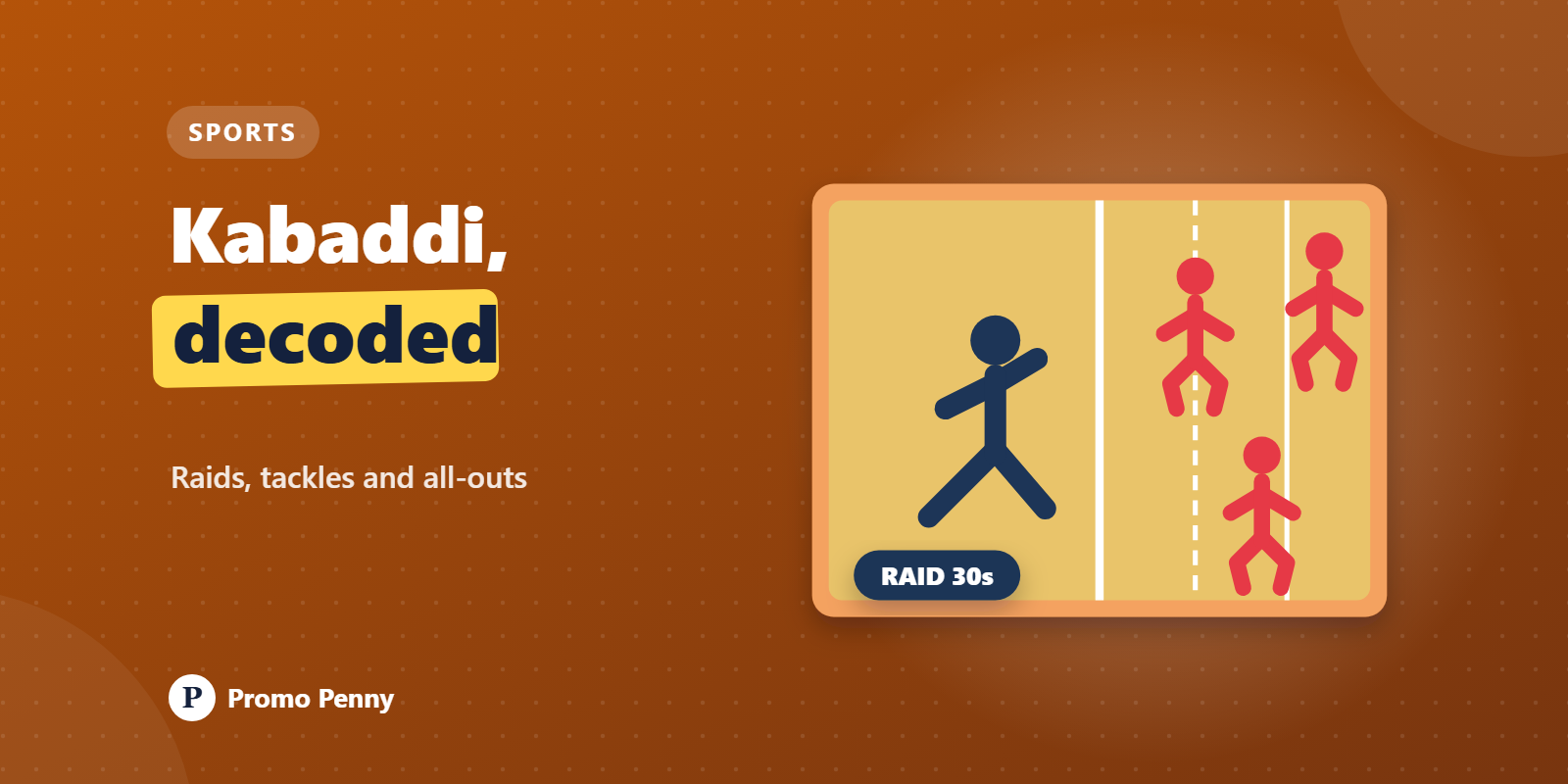
A kabaddi raid lasts about as long as an ad break. In that time one player walks into a half guarded by seven opponents, tries to touch as many of them as he can, and then tries to get back across the middle without being dragged to the mat. That is the whole sport in two sentences. Everything else is scoring detail.
If you have switched on a Pro Kabaddi League match and felt lost the moment the commentator shouted "super tackle", this guide is for you. The numbers below follow the well-established professional league format. Leagues do tweak rules from season to season, so if something on screen doesn't match, the league's own current rulebook wins.
Each team has seven players on the mat and a handful of substitutes on the bench. The court is split by the midline, and each team defends its own half.
Inside each half, two lines decide a lot of what happens:
The strips along the sides are called the lobby. They are out of play until there is a struggle, meaning contact between the raider and a defender. Once a struggle starts, the lobby becomes part of the court for the players involved. A player who steps out of bounds without a struggle is simply out.
Teams take turns sending one raider into the opposition half. In the pro format each raid runs on a 30-second clock. The traditional rule called the cant also applies: the raider keeps chanting "kabaddi, kabaddi" throughout. That is the murmur you hear as raiders cross the midline.
A raid ends in one of three ways.
Watch the raider's hand at the end of a struggle. Very often he is lying flat, half caught, stretching one finger across the midline. If any part of his body touches his own half before the defenders finish him off, the raid counts as successful.
When the defending side has six or seven players on the mat, the raider can earn a bonus point by touching the bonus line with one foot while his other foot is in the air. The trailing-leg stretch you see near the back of the court is exactly this.
Two details trip up new viewers. A bonus point does not put any defender out. And if the raider grabs a bonus and then gets tackled, both teams score: one bonus point to the raiding side, one tackle point to the defenders. Bonus points also don't revive players, which matters in the section on revivals.
Because the bonus is only available against six or more defenders, smart teams sometimes keep fewer players on the mat late in a half just to switch it off.
Defenders work in pairs and chains. You will hear names like ankle hold, thigh hold, block and dash, but the scoring question is simple: did they stop the raider from getting home?
The super tackle is the defenders' big reward. If the defending team has three or fewer players on the mat and still tackles the raider, they get two points instead of one. Raiders often get greedy against a thin defence, and that is when a super tackle tends to happen.
On the attacking side, the term to know is the super raid: any raid that earns three or more points.
Each team's run of empty raids is counted. After two empty raids in a row, that team's third raid becomes a do-or-die raid. The raider must score at least one point, by touch or bonus. If he comes back empty-handed, he is declared out and the defending side gets a point.
The count resets as soon as the team scores on a raid. This rule exists to stop teams from running down the clock with safe, pointless raids, and it makes the third raid tense to watch, because the defenders know the raider has to come at them.
Players who are out sit in a block beside the court. Each point a team scores from a touch or a tackle brings back one of its out players, in the order they went out.
If a team loses every player on the mat, the opponents inflict an all-out. They get two extra points, and the side that was wiped out brings all seven players back on together.
Here is how fast it can swing. Say Team A is down to two players. Team B's raider touches both and gets home. Team B scores two touch points plus two all-out points, four in one raid, and two of Team B's own out players come back to the mat. Meanwhile Team A restarts at full strength but four points behind. That is why commentators get excited when a side is down to its last two or three.
A pro match has two halves of 20 minutes each with a five-minute break, and the teams switch sides at half-time. Raids alternate between the teams throughout. The team with more points at the end wins.
In the league stage a tie stays a tie and the points are shared. In knockout matches a tie-breaker settles it, and the format of that tie-breaker has varied, typically a short set of raids by each team. Teams also get a limited number of timeouts and substitutions within limits the league sets.
Once you know the rules, a few numbers on screen tell you what is about to happen:
Keep those four in your head for your first match and you will be calling super tackles before the commentator does.






























© 2026 Promo Penny. All rights reserved
Designed & Developed by IngeniousPro Team.